Track Lights
 Linear Lights
 Track System
 Decorative Lights
 Recessed Light
 Pendant lights
 Surface mounted lights
 Panel lights
 Street Lighting
 Magnetic Lighting System 48V
 Magnetic Lighting System 48V
 Invertors
 Lighting control
Fuel station lighting: canopy, shop, café, site
At night a driver sees a fuel station from a kilometre away, before the logo and the prices on the price pylon. In those few seconds they decide whether to leave the motorway. So fuel station lighting does more than let people see. It stops the car, guides the driver from the pump to the till and keeps them in the café. Below we go through the station zone by zone: what to light, how many lux to plan, which luminaires to use and where mistakes are most common.
A fuel station is four buildings under one roof
A modern station combines a road facility, an industrial zone, a shop and a café. Each has its own job for light, and one solution for the whole station does not work.
| Zone | Job of the light | How we light it in practice | Colour temperature | What we use |
|---|---|---|---|---|
| Approach and site | show the entry, driveway and parking without glaring the road | light along the driveway, none on the road | 4000–5000 K | cantilever street luminaires with road optics |
| Canopy over the pumps | safe refuelling and payment | even across the whole pump area, no excess | 4000–5000 K | recessed or surface luminaires with flat glass, IP65 or higher |
| Shop | sell the goods | up to 1,500 lx on the goods, accent on shelves and till | 4000 K, Ra 80 or higher | track spotlights or linear luminaires above the shelving |
| Café | let people rest | about 800 lx on the tables, soft light | 3000–4000 K | linear or pendant luminaires without glare |
The figures in the table come from our fuel station project in the Rivne region, not from regulations. Fuel station networks light to their own standards, because shop and café sales depend on it, and the levels on the goods are several times higher than general norms.
Canopy: enough light, not maximum light
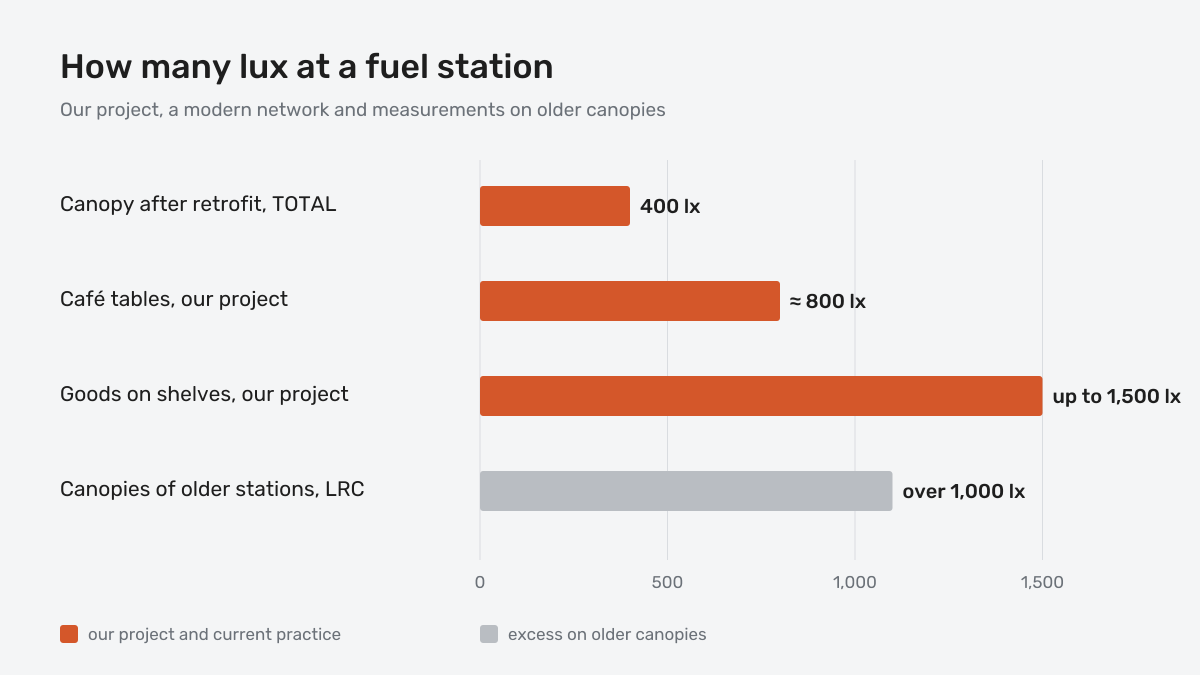
The most common canopy mistake is too much light. According to a Lighting Research Center (USA) review, illuminance under fuel station canopies often exceeds 1,000 lx. At the stations LRC measured itself, the canopy centre ranged from 122 to 1,090 lx, and at one of them the new system installed in a retrofit delivered 642–1,055 lx. For comparison: after its retrofit the TOTAL network runs at 400 lx at the pumps, and that is enough for drivers.
Excess light does damage twice. First, it is paid for every night. Second, a driver leaving a 1,000 lx canopy for a road lit to 10–20 lx faces a 50- to 100-fold difference. The eyes need time to re-adapt, and older drivers find it hardest. That is exactly when the car pulls onto the road.
So a canopy is designed from the level it needs, not to be the brightest in the area. A smooth transition comes from bright poles and the edges of the site, not from spotlights aimed outwards from the canopy.
Flat glass versus the drop lens
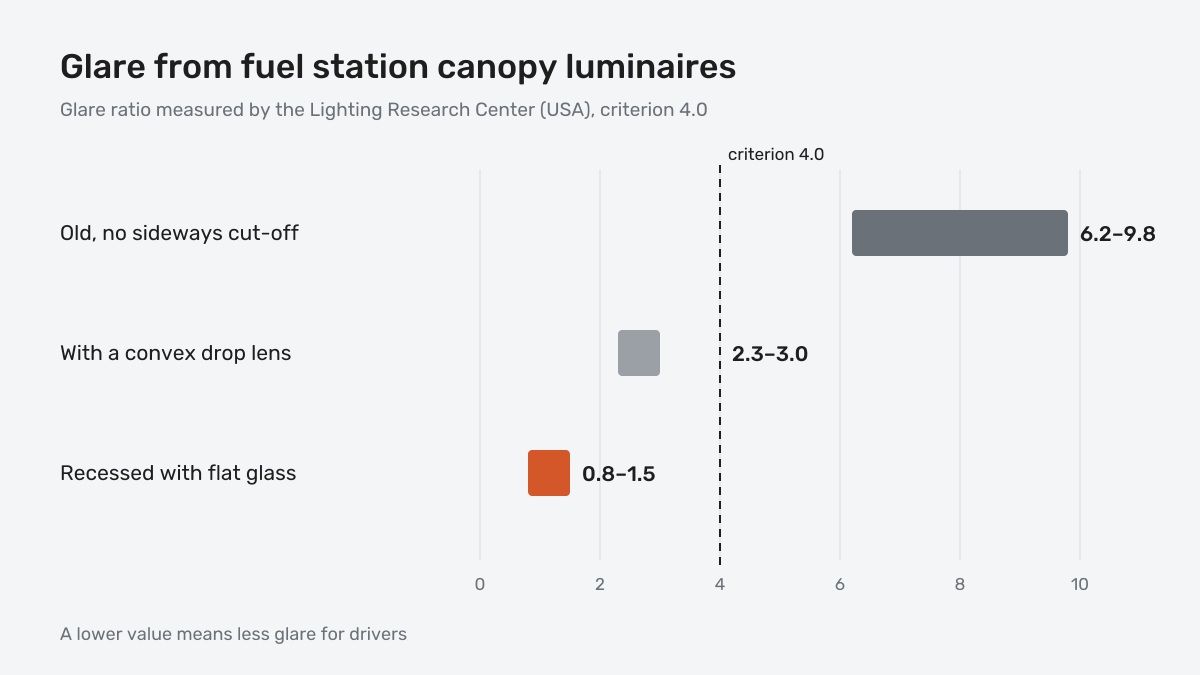
The second mistake is the shape of the luminaire. A luminaire with a convex glass hanging below the canopy also throws light sideways: into neighbours’ windows, into the eyes of drivers on the road, into cameras. LRC compared three types of canopy luminaires by glare ratio (criterion 4.0):
- old luminaires without sideways cut-off: 6.2 to 9.8;
- with a convex drop lens: 2.3 to 3.0;
- recessed with flat glass: 0.8 to 1.5.
Recessed flat-glass luminaires produced the least glare and the lowest power per 100 lx: 549 W against 1,394 W in the original system as found. So on a canopy we use recessed or surface luminaires with flat glass, no drop lens, and we do not light the canopy fascia from below.
Hazardous zones: height decides
Fuel dispensers are surrounded by hazardous (explosive) zones. Under the EI/APEA industry code for petrol filling stations, as quoted by Ireland’s Health and Safety Authority (HSA), Zone 1 at a dispenser without vapour recovery covers a 4.25 m radius (hose length plus 0.5 m) from the hose connection, up to 1.2 m above ground. With working vapour recovery the same space is Zone 2. Only explosion-protected (Ex) equipment is allowed in either zone. If the canopy sits 4.5–6 m high, luminaires in its soffit end up outside these zones. But the zone boundaries for a particular station are set by its own design, so check its hazardous-area drawing before choosing luminaires, not a typical value.
The other requirements for a canopy luminaire are simpler. Ingress protection IP65 or IP66, because rain and wash water get under the canopy. Impact resistance IK08 or higher. An operating range from −30 °C, because the canopy is not heated in winter.
Shop: light that sells, not just lights
A driver pops into the shop briefly and has a few minutes to notice coffee, hot food and the drinks shelves. Here even general light loses to accent light. Even general light makes sure the floor is visible, but vertical light on the shelves is what sells.
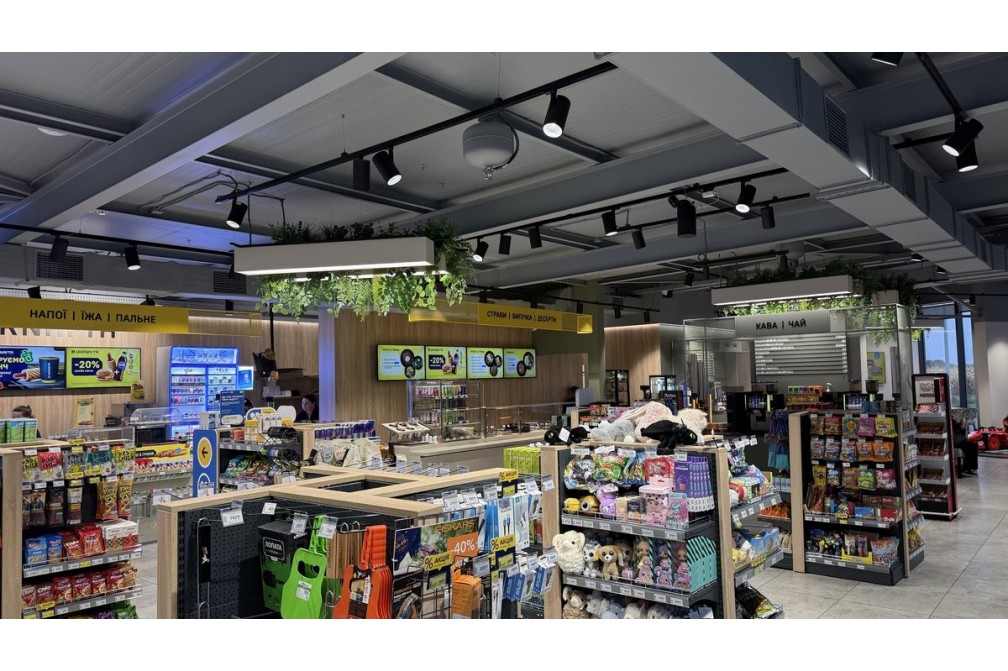
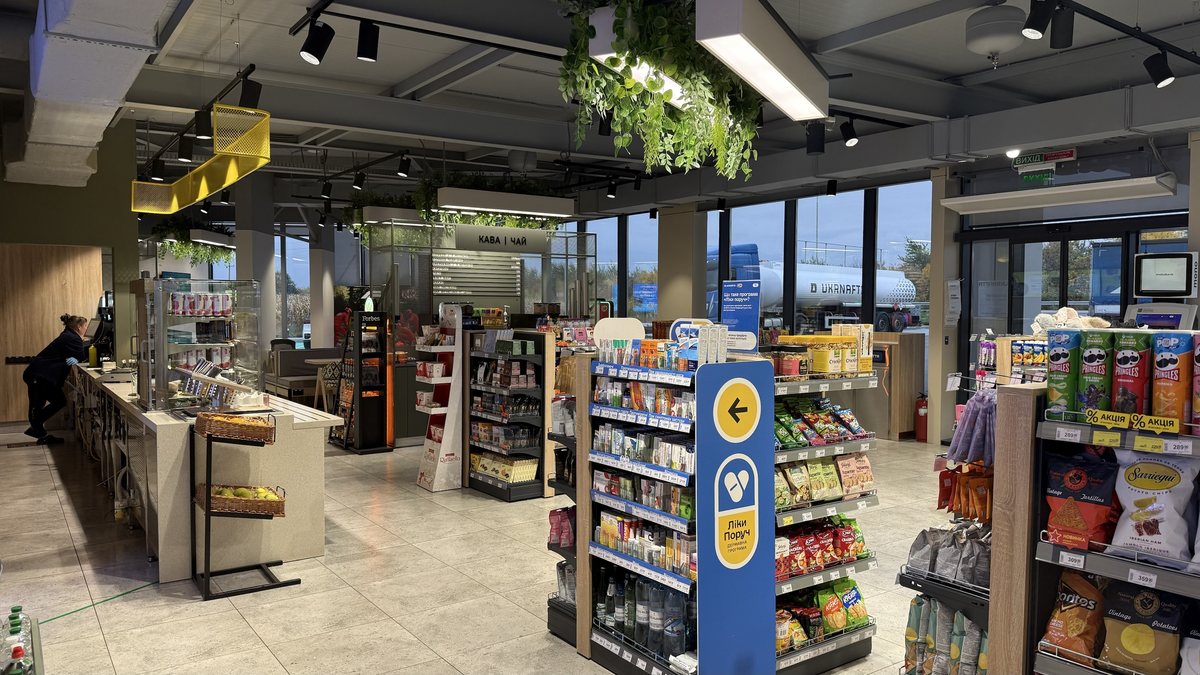
In our fuel station project in the Rivne region, the shop lighting is built on 60 SHOOTER-L track spotlights under an open ceiling, with the busbar hung at 3.5 m. 69.5 m of TRACK-3F busbar runs along the shelving and over the till, with up to 1,500 lx on the merchandise. Beam angles of 24°, 38° and 60° are matched to shelves, aisles and wider areas. The busbar has three independent lines, so some spotlights were wired to a separate emergency lighting group without a separate set of luminaires.
Keep one colour temperature inside the station, 4000 K with Ra 80 or higher, so packaging, drinks and food look natural. How to choose beam angles, tilt and spacing is covered separately: how to choose track spotlights.
Café: different light, different behaviour
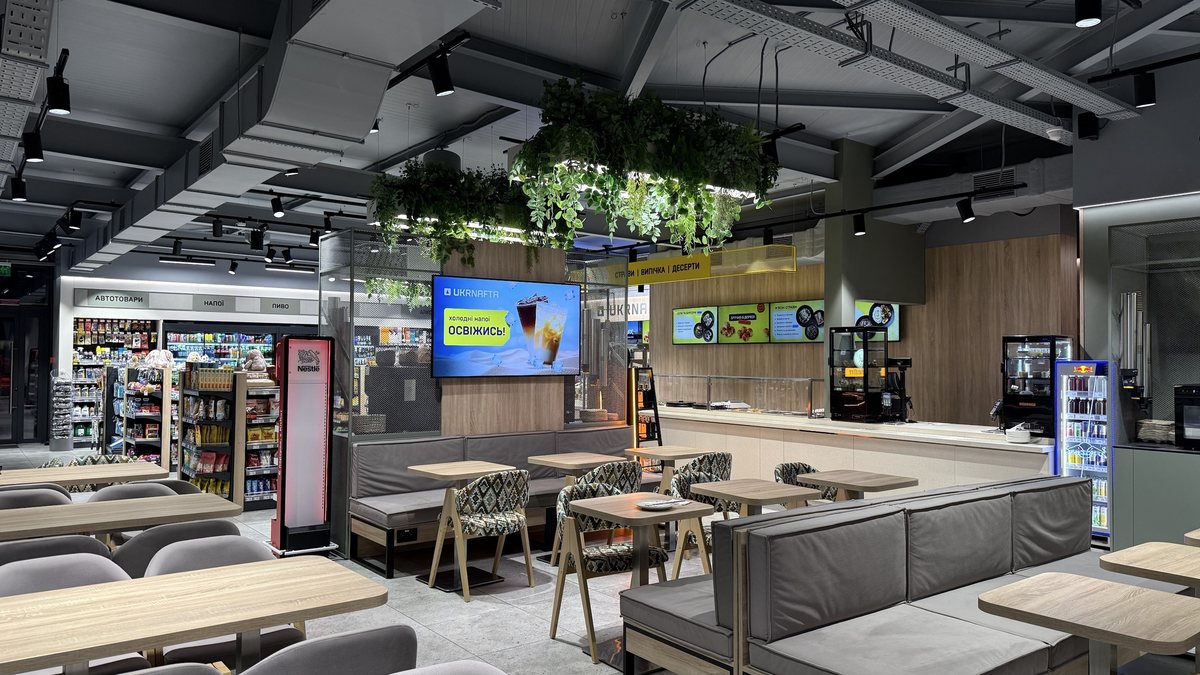
A fuel station café cannot be lit like the shop. People sit facing the room, so direct light from spotlights hits their eyes. In the same project, LINK linear luminaires hang above the tables in planted structures: about 800 lx on the tables, yet the light is soft and does not glare.
The hot food counter and the coffee island are lit by the same spotlights as the shop, aimed at the counters. The food looks appetising and the barista can see what they are doing. For washrooms and corridors, recessed luminaires with a narrow beam are enough, like AISLE in this project: the light falls down and does not wash the wall panels.
Site and facade: be visible without glaring the road
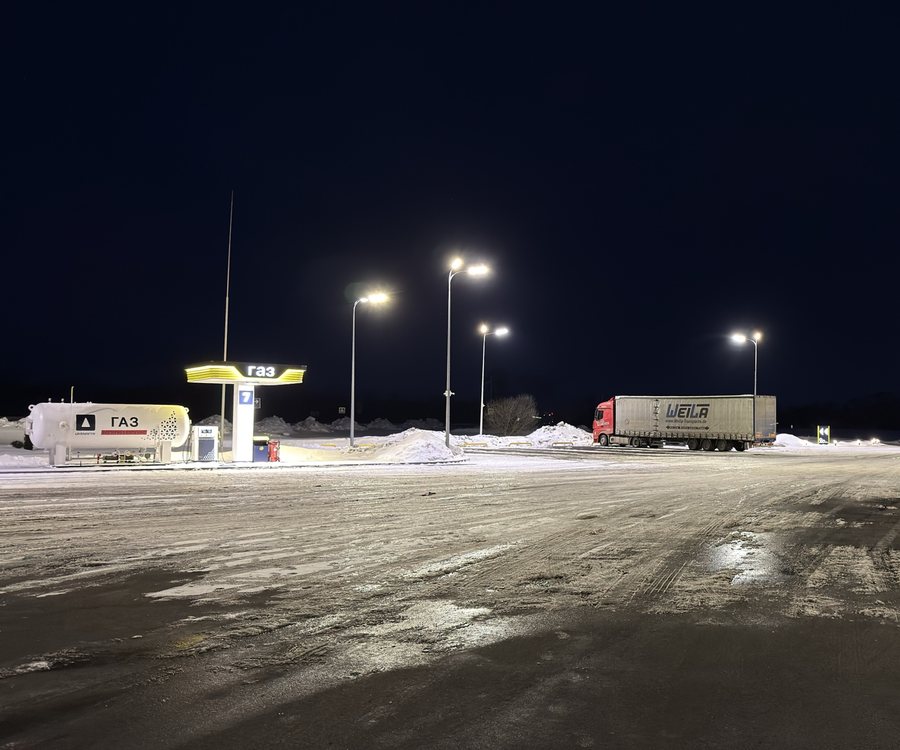
Approaches and parking are lit by cantilever street luminaires with road optics. At the station from our project these are ROUNDABOUT 150 W with T2M optics and 5000 K. The optics stretch the light along the driveway, and the cooler white separates the site from the dark road. For sites, car parks and canopies there is also the ALLEY series, mounted on a pole, bracket or slat.
The facade and the price pylon are lit so that light lands on the surface instead of going into the sky and onto the road. The terrace can be warmer than the shop: in this project 3000 K in-ground luminaires light the facade next to the tables, and sealed LINK IP65 luminaires light the terrace itself.
Controls: savings without dark pumps
The biggest saving at a fuel station lies in its operating hours. The station is lit 24 hours a day, while at night there are far fewer cars. A few known examples:
- in a retrofit, the TOTAL network in the Netherlands and Belgium raised pump-area illuminance from 200 to 400 lx while cutting consumption by 70 %, and sensors dim the light to 70 % when no car is at the pump (Philips data);
- the lighting design for one BP station in New Zealand provides for dimming part of the canopy to 30 % at night;
- a study for the utility SDG&E in California showed the opposite case: at a busy station, bi-level occupancy control never engaged, because cars kept coming without a break.
At a new fuel station near Kyiv, which we took from lighting design to commissioning, 227 luminaires are joined in a DALI control system on the Dynalite platform. The shop, café and site have their own groups and scenes, so the station can switch to night mode without a single dark corner. The key interior element there is a set of perforated light panels that work both as luminaires and as part of the design.
The conclusion is simple: controls pay off where the night has “empty” hours. Time-based scenes, occupancy sensors in back rooms and washrooms, and separate groups for the shop, café, canopy and facade work at any station. We showed how to calculate the effect in our article on the total cost of ownership of lighting, and DALI equipment is collected in the lighting control section.
Common mistakes
- A canopy “at maximum”: 1,000 lx or more under the canopy and a sharp transition to the dark road.
- Convex-glass luminaires or spotlights aimed outwards from the canopy: glare for drivers and light in neighbours’ windows.
- One colour temperature for the whole station: cold light makes the café feel like a warehouse.
- A shop on general light only: even, but the goods on the shelves look dull.
- One power circuit for everything: the canopy cannot be dimmed without switching off the shop.
- Choosing luminaires without the hazardous-area drawing.
How to plan fuel station lighting: step by step
- Split the station into zones: site, canopy, shop, café, terrace, back rooms.
- For each zone, record the illuminance, uniformity, colour temperature and Ra.
- Check the canopy height against the hazardous-area drawing.
- Choose the optics: road optics for driveways, flat glass for the canopy, narrow beams for the merchandise.
- Plan separate power groups and control scenes by operating hours.
- Verify everything with a DIALux lighting calculation before purchasing.
Fuel station lighting by Vision Lighting
We manufacture luminaires in Ukraine and do the lighting calculation for every zone of the station. For the shop and café that means SHOOTER track spotlights on TRACK-3F busbar and LINK linear luminaires, for the site and canopies ROUNDABOUT and ALLEY street luminaires, and recessed AISLE for back rooms. Examples: a fuel station in the Rivne region with track lighting under an open ceiling, a fuel station shop retrofit in Kyiv without rebuilding the interior, a fuel station network in Kyiv with linear light in the shop and street lighting on the site. All fuel station projects are in our completed projects section.
Frequently asked questions
How many lux are needed under a fuel station canopy?
There is no single figure: the network’s standard sets the level. What matters is even light across the whole pump area. TOTAL’s retrofit went to 400 lx. The 1,000 lx or more often found at older stations makes the transition to the dark road harder for drivers leaving.
Which colour temperature suits a fuel station?
4000–5000 K for the site and canopy. 4000 K with Ra 80 or higher in the shop, so the goods keep their natural colours. The café and terrace can be warmer, 3000–4000 K.
Do canopy luminaires need to be explosion-protected?
Under the EI/APEA code the hazardous zone at a dispenser reaches 1.2 m above ground, so canopy luminaires at 4.5–6 m sit outside it. The final answer comes from the hazardous-area drawing of the specific station.
Which luminaires should go on the canopy?
Recessed or surface luminaires with flat glass, IP65 or IP66, IK08 or higher, with an operating range from −30 °C. Convex-glass luminaires produce more glare and more light beyond the site.
How much can a fuel station save on lighting?
Replacing outdated luminaires with LED cut consumption by 50–70 % in known examples. Controls add savings during hours when the station has few cars.
Sources: Lighting Research Center, “Canopy lighting” (field measurements of fuel station canopies); HSA (Ireland), “Fire and explosion risks in service stations”; Flagstaff Dark Skies Coalition; Philips, TOTAL case study; ETCC, report ET12SDGE0001.