Track Lights
 Linear Lights
 Track System
 Decorative Lights
 Recessed Light
 Pendant lights
 Surface mounted lights
 Panel lights
 Street Lighting
 Magnetic Lighting System 48V
 Magnetic Lighting System 48V
 Invertors
 Lighting control
What store lighting costs over 10 years
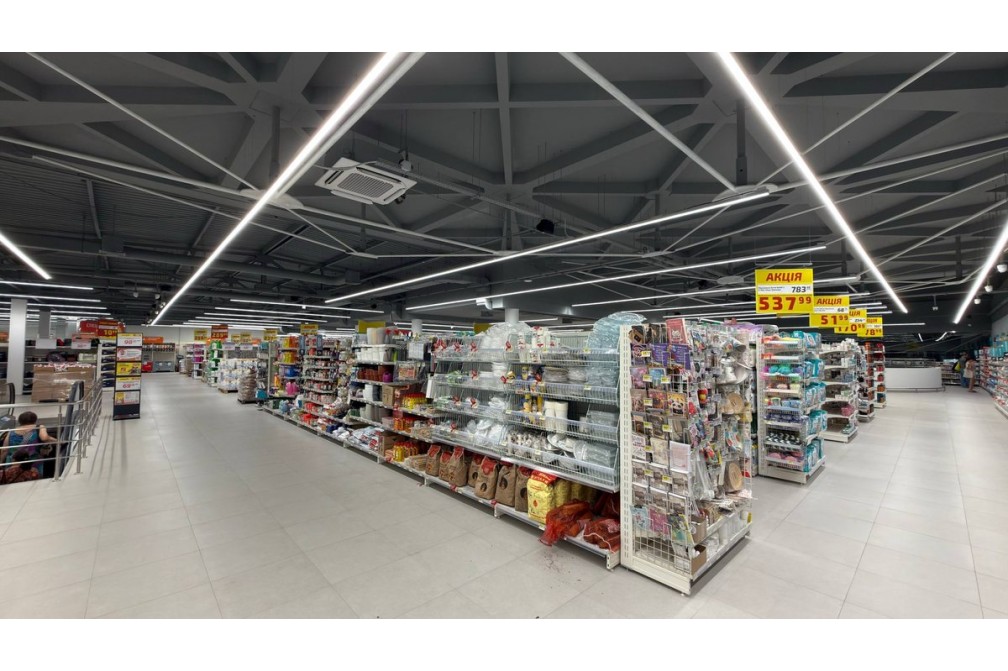
Lighting is bought at the price in the estimate but paid for every month in the electricity bill. For a store open 16 hours a day, the electricity bill for lighting in the first year usually exceeds the price of the luminaires themselves. Comparing options by purchase price means looking at the smaller part of the cost.
Below we break down what the total cost of ownership (TCO) of lighting consists of and calculate it for a 1,000 m² sales floor.
What makes up the total cost of ownership
The total cost of ownership is everything the owner pays for lighting over its service life:
- purchase: luminaires, track, mounting, controls;
- installation and design: labour, lighting calculation;
- electricity: power × operating hours × tariff;
- maintenance: replacing failed drivers and luminaires, electrician call-outs, zone downtime;
- light loss over time: LEDs dim, so the system is designed with a reserve, and this reserve also consumes energy.
On a sales floor, electricity is the largest cost item. The purchase matters, but it is a one-off.
The key metric: W per square metre at the required illuminance
Comparing luminaires by unit price or even by the wattage of one unit makes little sense. What matters is how many watts per square metre must be installed to get the required lux on the shelves.
Annual consumption depends on this metric. It is determined not only by the light source but also by the optics: a luminaire with the right beam angle puts light on the shelving, not on the ceiling and into the aisle. That is why two solutions with the same illuminance on the merchandise can differ in wattage by a factor of one and a half.
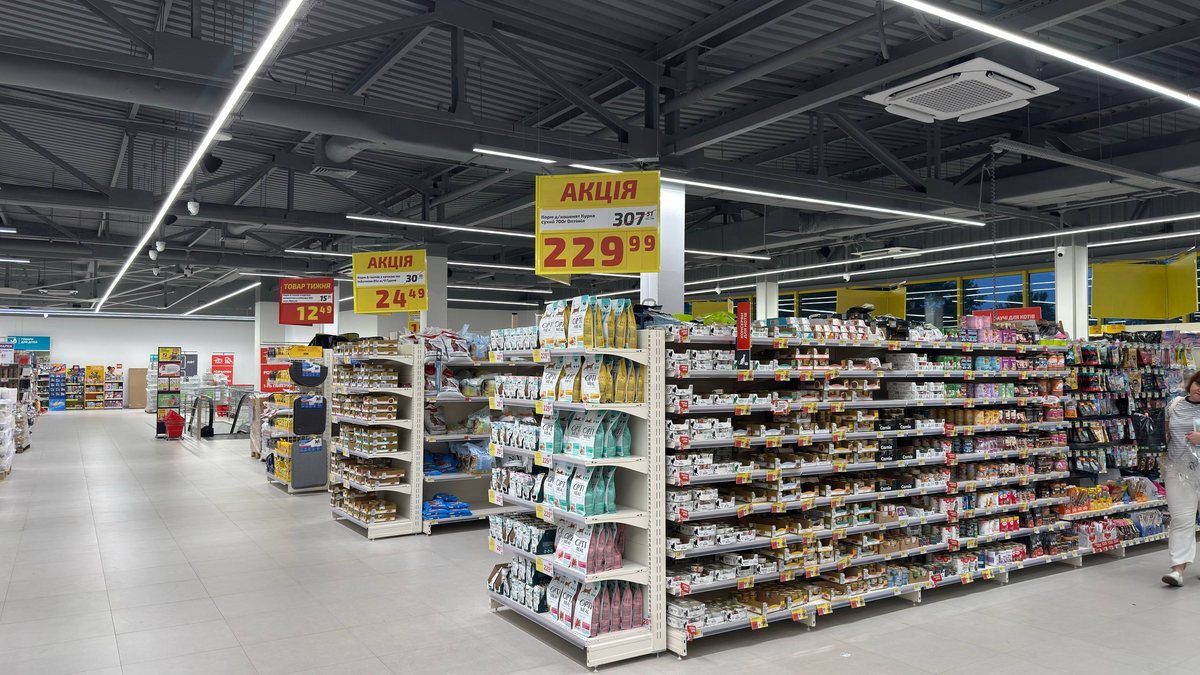
For reference: in one of our projects, a 1,440 m² supermarket in Kyiv with RAY-L and RAY-D linear luminaires, the DIALux calculation gives an average of 1,218 lx and 1,027–1,273 lx on the shelving at 9.9 W/m².
Calculation: a 1,000 m² sales floor over one year
Assumptions:
- area 1,000 m², target about 1,000–1,200 lx on the merchandise;
- operation 16 hours a day, 365 days: 5,840 hours a year;
- tariff 10 UAH per kWh (for businesses in Ukraine in 2026 the price ranges from about 6 to 20 UAH depending on the contract and time of day; the day-ahead market average in February was about 9 UAH; use your own).
| Option | Installed power | Consumption per year | Cost per year |
|---|---|---|---|
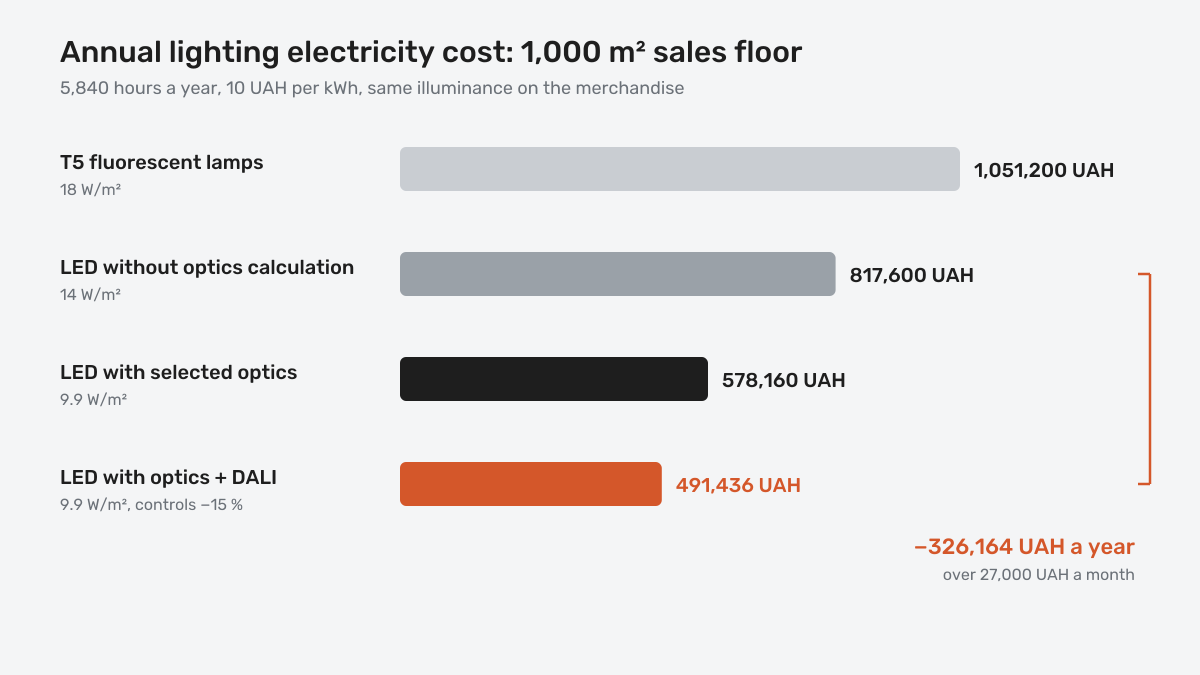
| T5 fluorescent lamps, 18 W/m² | 18 kW | 105,120 kWh | 1,051,200 UAH |
| LED luminaires without optics calculation, 14 W/m² | 14 kW | 81,760 kWh | 817,600 UAH |
| LED luminaires with selected optics, 9.9 W/m² | 9.9 kW | 57,816 kWh | 578,160 UAH |
| Same + DALI control (−15 %) | 9.9 kW | 49,144 kWh | 491,436 UAH |
14 and 18 W/m² are typical values for a one-for-one replacement without a calculation. The 9.9 W/m² value comes from the real project above.
The difference between the second and fourth rows is 326,164 UAH a year, or more than 27,000 UAH a month.
What lighting control delivers
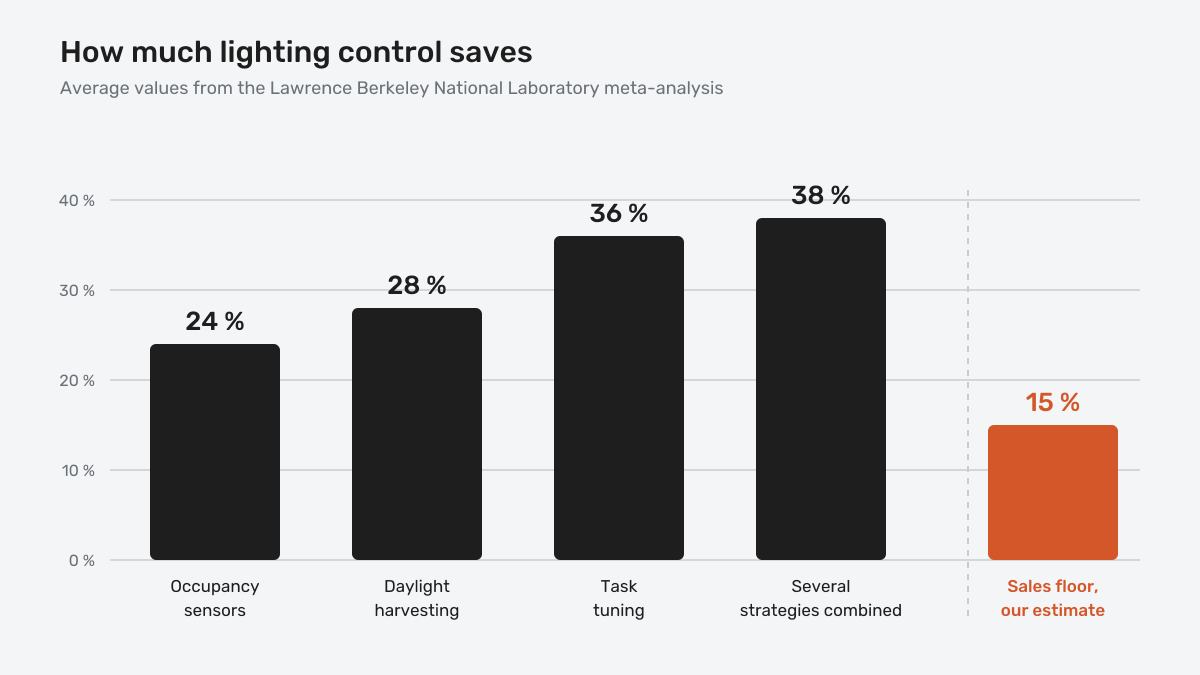
Lawrence Berkeley National Laboratory compiled the results of studies on lighting control in commercial buildings in a meta-analysis. Average savings by strategy:
- occupancy sensors: 24 %;
- daylight harvesting: 28 %;
- task tuning: 36 %;
- several strategies combined: 38 %.
On a sales floor, occupancy sensors only work in back-of-house areas, and there is little daylight. So we use a cautious 15 % in the calculation: lower levels during quiet hours, night mode after closing and level tuning by zone. Savings are higher in warehouses, offices, corridors and restrooms.
Constant light output brings a separate effect. LEDs dim over time. To have the required light level on the shelf at the end of the service life, a new system is designed with a reserve: with a maintenance factor of 0.8, 25 % more light than needed is installed at the start. A driver with constant light output (CLO) starts at lower power and raises it gradually, so the excess light of the first years is not paid for.
Maintenance: failures you do not see in the estimate
In an LED luminaire it is most often the driver that fails, not the LEDs. The cost of a failure is not limited to the part price: an electrician's call-out, a lift, work outside opening hours, a dark area above the merchandise.
Example for 250 luminaires and 1,500 UAH per replacement including labour:
- 5 % failures a year: 12–13 replacements, about 18,750 UAH a year;
- 1 % failures a year: 2–3 replacements, about 3,750 UAH a year.
The failure rate depends on driver quality, operating temperature and whether the driver runs at the limit of its power. These figures are a calculation model, not warranty values.
Payback and ROI
If the solution with selected optics and controls costs more to buy, the difference is compared with the annual savings:
payback = purchase price difference ÷ annual savings
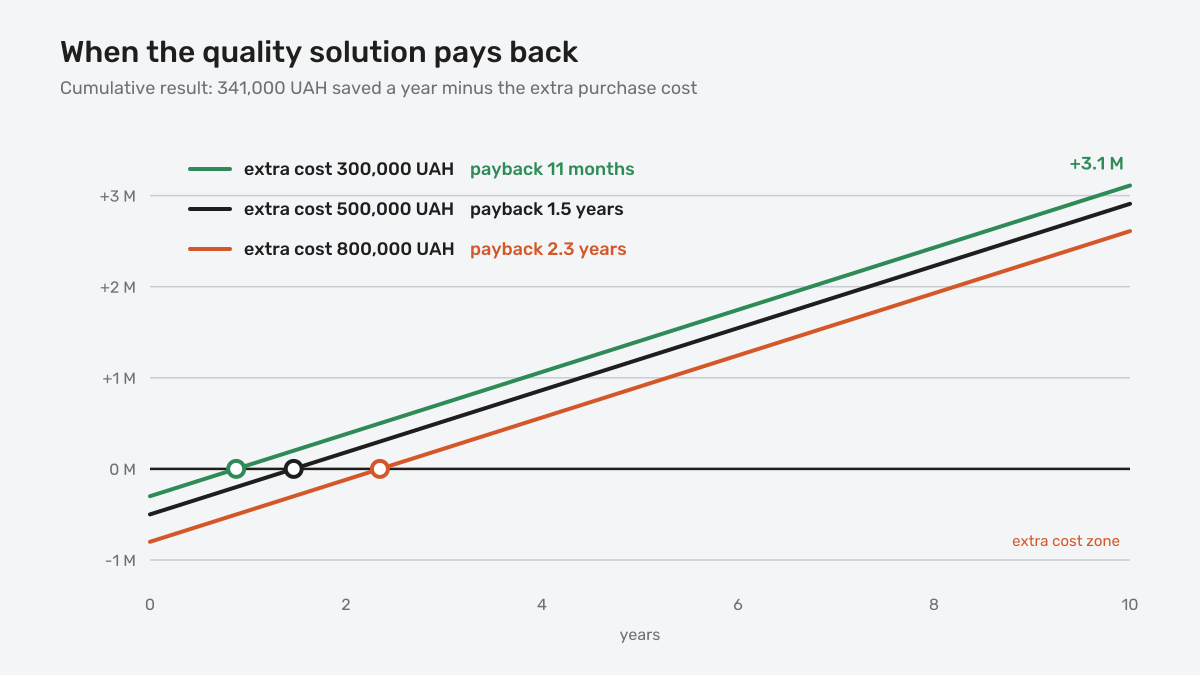
In our example the annual saving is 326,164 UAH on electricity and about 15,000 UAH on maintenance, about 341,000 UAH in total.
| Extra cost of the quality solution | Payback |
|---|---|
| 300,000 UAH | about 11 months |
| 500,000 UAH | about 1.5 years |
| 800,000 UAH | about 2.3 years |
Over 10 years the difference in operating cost is about 3.4 million UAH at a constant tariff. If the tariff rises, payback will be even shorter: at 15 UAH per kWh, electricity savings alone reach 489,000 UAH a year.
Common mistakes when comparing
- Comparing luminaire prices instead of W/m² at the same illuminance. A cheaper luminaire often needs more units or more power.
- Ignoring operating hours. 2,500 hours a year in an office and 5,840 hours in a supermarket give a different payback for the same solution.
- One-for-one replacement of old lamps. Without a calculation the old layout remains, and part of the light goes into the aisles.
- Leaving out controls. Adding DALI to an installed system costs more than planning it in the project.
- Not counting maintenance. Driver failures in a high hall cost more than expected because of work at height.
How to calculate for your project
- Define the required illuminance by zone: sales floor, fresh zones, checkout, warehouse.
- Run a lighting calculation for each option and compare the installed power in W/m².
- Count the operating hours per year and use your own tariff.
- Add control scenarios and maintenance.
- Compare the purchase price difference with the annual savings.
How we calculate at Vision Lighting
For every retail project we run a DIALux lighting calculation by zone and show the installed power in W/m², the illuminance on the merchandise and the annual consumption. We select optics for the shelving and mounting height so the light works for the merchandise: RAY-L linear luminaires with lenses for aisles, SHOOTER track spotlights for accents (how to choose them is covered in the article "How to choose track spotlights"), DALI control for the store's operating scenarios.
If you have a floor plan, send it to us: we will calculate the options and show what the lighting will cost not only at purchase but over 10 years of operation.
FAQ
What does the total cost of ownership of lighting include?
Purchase, installation, electricity over the service life, maintenance and component replacement. In a store with long opening hours, electricity is the largest share.
How fast does replacing fluorescent lamps with LEDs pay back?
It depends on operating hours, the tariff and the quality of the new solution. In the 1,000 m² example, consumption drops from 105,000 to 49,000–58,000 kWh a year, and an extra cost of several hundred thousand hryvnias pays back in 1–2 years.
How much does DALI control save?
According to Lawrence Berkeley National Laboratory, 24 to 38 % depending on the strategy. On a sales floor it is reasonable to expect 10–20 %, more in auxiliary areas.
Why does W/m² matter more than the wattage of one luminaire?
Because the electricity bill depends on the total installed power. A luminaire with the right optics delivers the same illuminance on the merchandise with fewer watts per square metre.
Which tariff should I use for the calculation?
Your actual tariff from the supplier contract, including distribution. For a quick estimate, use 10 UAH per kWh and check the sensitivity at 8 and 15 UAH.
Sources: Williams A., Atkinson B., Garbesi K., Rubinstein F. A Meta-Analysis of Energy Savings from Lighting Controls in Commercial Buildings. LBNL-5895E, 2012. DIALux calculation of a completed 1,440 m² supermarket project (Vision Lighting). Electricity prices for businesses in 2026: netfreedom.org.ua.