Track Lights
 Linear Lights
 Track System
 Decorative Lights
 Recessed Light
 Pendant lights
 Surface mounted lights
 Panel lights
 Street Lighting
 Magnetic Lighting System 48V
 Magnetic Lighting System 48V
 Invertors
 Lighting control
Beauty salon lighting: design and choice of light
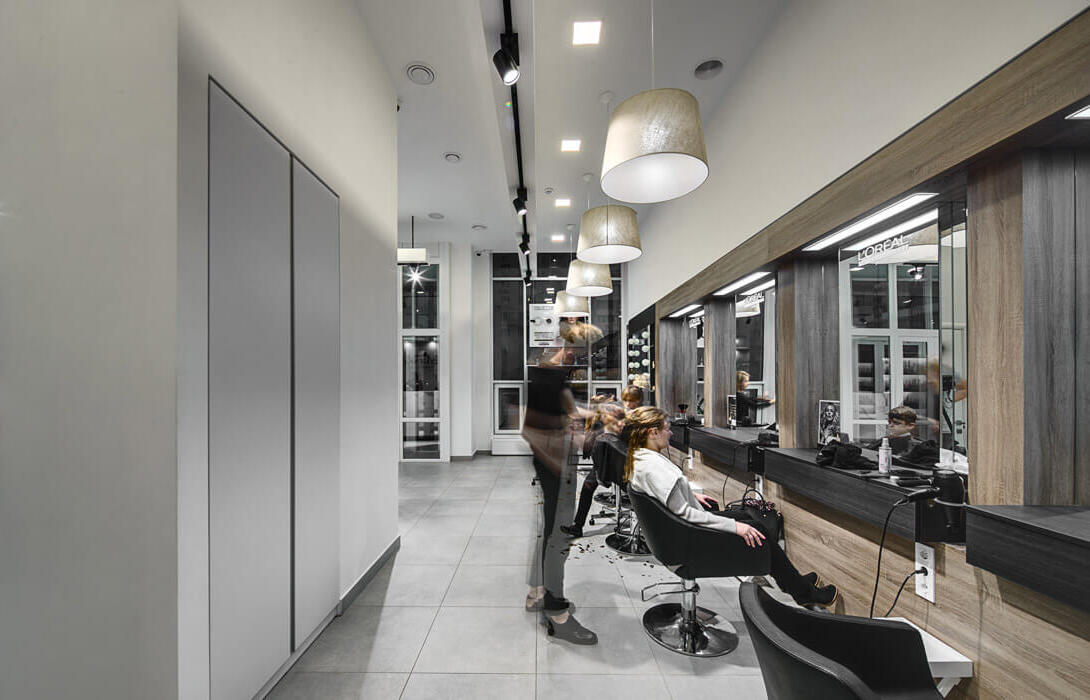
Lighting in a beauty salon is a working tool for attracting and keeping clients. Light decides how precisely the stylist works, how correctly colours are seen (hair, skin, make-up, nail coatings), the quality of photo and video content and the overall impression visitors take away. That is why professional salon lighting always starts with lighting logic: understanding the zoning of the space and the function of each part of it, and a conscious choice of finishes and furniture that may reflect light.
The beauty sector has an important nuance: a client comes not only for the service but also for conversation, a pleasant experience and a sense of comfort. Light directly shapes the atmosphere and the impression of being in the space, and cold flickering sources or the wrong colour temperature can spoil even an expensive fit-out. Good salon lighting has to give enough visibility, a pleasant experience for clients and convenience for the stylist.
Why salon lighting cannot be chosen from a catalogue
Trying to simply buy salon lighting "like someone else has" almost always ends in a compromise. Even two spaces of similar size have different parameters: ceiling height and type, wall colour, floor material and layout, so they need different solutions. Ceiling height, wall and floor colour, the number of mirrors and glossy surfaces, the position of workstations and aisles and the set of services all differ. All of this changes the distribution of light, the level of reflections and, in the end, how shades are perceived.
In the hairdressing zone, for example, stable colour rendering and comfort during long working hours become key, while in the nail zone it is the direction of light and control of shadows on the hands, so the technician sees fine detail without dark gaps or overexposure. So it makes more sense to design salon lighting zone by zone: first define the requirements for each zone, then choose luminaires and optics for the specific tasks rather than for a generic universal scenario.
Basic parameters that define lighting quality
For light to work predictably, a project fixes several parameters:
- Illuminance (lx). The amount of light on the working surface. For a salon, not only the general value across the floor matters, but also the level at the stylist's workstation.
- Colour rendering (CRI/Ra). The higher the value, the more accurately shades are seen. In the beauty industry this is critical for colouring, make-up and matching tones.
- Colour temperature (K). Light that is too cool makes skin look pale and the atmosphere uncomfortable. Light that is too warm distorts some shades and turns the picture yellow.
- Discomfort glare (UGR). Even with the right lux level, eyes get tired if the light source is in the field of view.
- Distribution and direction of light. Vertical illuminance (at face and mirror level) matters, as does the absence of stray reflections on gloss and mirrors.
Zoning: how to lay out salon lighting by task
The most practical approach is to design salon lighting zone by zone. Then it becomes clear where an even background is needed, where working light, and where a soft atmosphere.
Reception and entrance lighting
Reception is the first point of contact. Here light affects trust: too dark and the space feels "closed", too cool and it looks unwelcoming. The entrance and reception area usually get good illuminance of around 350–400 lux, and the lighting scene combines a general background with accents on interior details and the reception desk. This makes the entrance friendly and easy to navigate.
Hairdressing area lighting
In the hairdressing area the work zone has to be bright and stable: the stylist constantly assesses the shape, texture and shade of the hair. A practical guideline is at least 500 lux at the workstation, but without sliding into glare. Comfort is critical here: recessed sources or indirect light with low glare work better (some projects aim for UGR below 15), so the stylist's eyes are not overloaded during the day.
The second key topic is colour rendering. In colouring it is important to hit the tone, and poor light with low colour rendering leads to perception errors. So for the hairdressing area it makes sense to choose solutions with high colour rendering and a stable spectrum, so the result looks the same in the salon and in daylight.
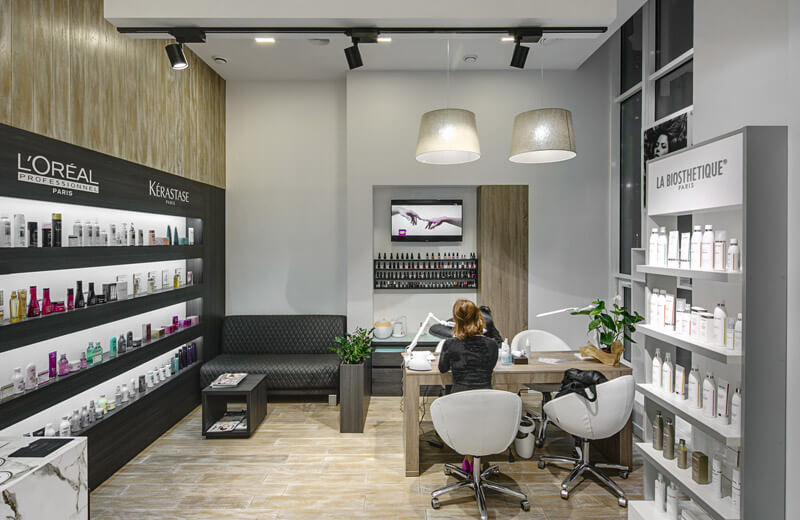
Manicure and pedicure lighting
The nail zone needs a lot of light and good legibility of fine detail. The general illuminance of nail service areas is often set at 550–600 lux. At the same time, ceiling lighting alone is not enough: each workstation should have its own lamp on an adjustable arm, so the technician can set the direction of light precisely and minimise shadows.
Colour rendering matters here too: with poor-quality sources clients often notice that the coating looks odd in daylight. So when choosing LED lamps and equipment for a salon, keep a minimum Ra guideline (for the nail zone practical recommendations often mention at least 80), and higher for the premium segment.
Make-up and cosmetology zones
For make-up, brows and cosmetology the priority is vertical illuminance and no hard shadows on the face. If light comes only from above, shadows under the eyes and on the cheekbones deepen and assessing the result becomes inaccurate. These zones usually combine soft general light with correctly aimed sources by the mirrors. It is also important to keep a neutral, comfortable colour temperature so the skin does not look pale or grey.
Which luminaires suit a beauty salon
The choice depends on the tasks of the zones and the architecture. As a rule the scheme has two layers: even base light and accent or task light.
- Recessed solutions and panels as an even background in halls and corridors (convenient for keeping uniformity).
- Linear luminaires for soft general light and for waiting areas and aisles.
- Track solutions as a tool for accents and flexible adjustment of light (convenient when the layout and accents change).
- Local lamps, on the desk or on adjustable stands, for nail zones and individual workstations.
If salon luminaires are chosen without a lighting design, the choice usually comes down to power and price. In practice this often leads to shadows at workstations, reflections in mirrors and an unfortunate colour temperature. It is more reliable to define lighting scenes by zone first and only then choose the solutions: linear and recessed luminaires for the general background, track spotlights for accents and LED equipment for workstations.
LED lighting in a beauty salon: why it is the standard
LED lighting is usually chosen for salons because of its stability, energy efficiency and service life. But what matters is not LED as such but the quality of light: no flicker, correct colour rendering and the right colour temperature. That is why in the beauty segment it is important to look not only at wattage and luminous flux but also at comfort and light quality parameters.
A separate question owners often bring is which lamps to choose so that the stylist sees shades correctly and the client feels comfortable. In practice it is important to avoid flicker, choose sources with adequate colour rendering and match the colour temperature to the zones: workstations, areas by the mirrors, waiting and reception. This gives a predictable result both in the stylist's work and in how the salon looks.
Top 3 mistakes most often seen in salons
- Too little general illuminance: the quality of the stylists' work and the clients' psychological comfort both drop.
- Poor-quality light sources: they distort the colour of hair, make-up and nails, which leads to complaints and a different result in daylight.
- Colour temperature that is too cool (above 5000K): skin looks pale and the atmosphere becomes less comfortable.
Example of a completed project: MIRA
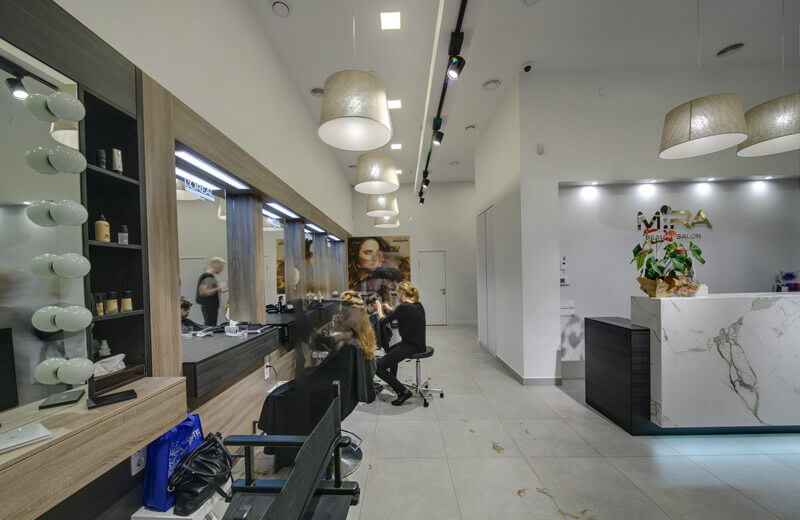
A good reference is real practice. In the MIRA beauty salon lighting project the emphasis was on comfort and function: separate illuminance levels for reception and work zones, glare control where stylists work for long hours, and accent lighting as part of how the interior is perceived. Accent lighting used PRIAGO and TECHNIK LED track spotlights mounted on a single-phase track. This approach gives flexibility: the direction of light can be adjusted to the layout and working scenarios. Read more
Summary: how to get the lighting right
The right lighting means stylists are comfortable at work, clients are comfortable in the space, and colours look natural and predictable. Technically this is achieved through a design: zoning, calculation of illuminance levels, UGR control, choice of colour temperature and sources with correct colour rendering.
If the task is to buy luminaires for a beauty salon and get a predictable result, it makes more sense to start with a lighting calculation. It helps choose solutions for the specific zones: reception, hairdressing area, nail zone, make-up and cosmetology, and waiting. With this approach light becomes part of the service and the quality of work, not a random set of fixtures.