Track Lights
 Linear Lights
 Track System
 Decorative Lights
 Recessed Light
 Pendant lights
 Surface mounted lights
 Panel lights
 Street Lighting
 Magnetic Lighting System 48V
 Magnetic Lighting System 48V
 Invertors
 Lighting control
DALI in a store: scenes and savings
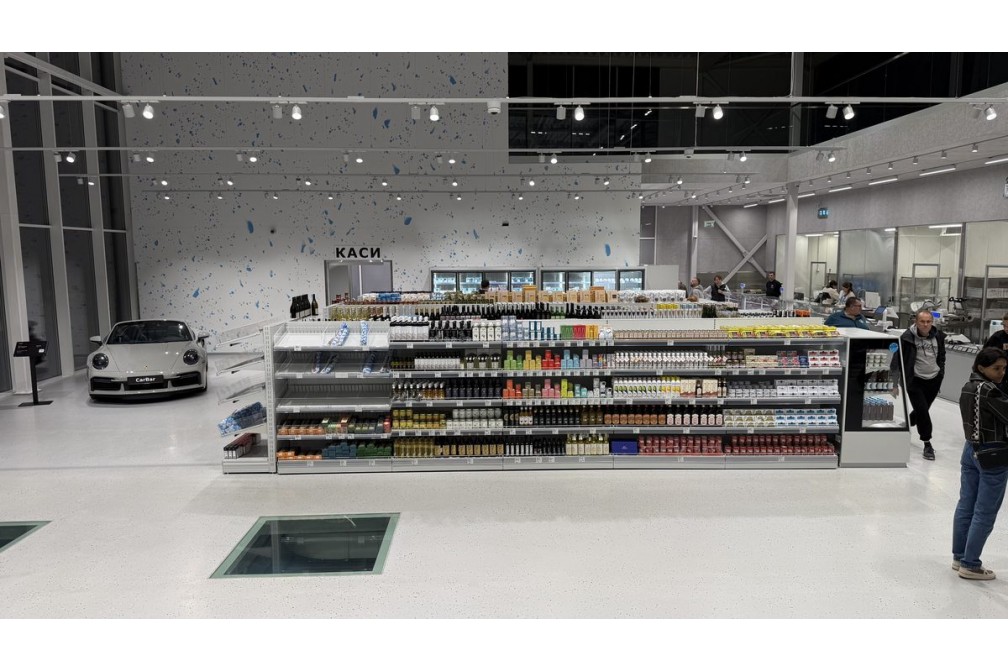
A supermarket is open from 8:00 to 22:00, yet the lights on the sales floor run at full power from 7:00 to 23:00. Staff stock the shelves for an hour before opening and clean for an hour after closing. A new installation gives more light than the design needs for the first years. And at night someone leaves a third of the floor switched on "so the cameras can see". All of this shows up on the monthly bill. DALI control removes these losses without changing the luminaires on the ceiling. Here is how it works, which scenes a store needs and what it is worth in money.
What DALI is, in plain terms
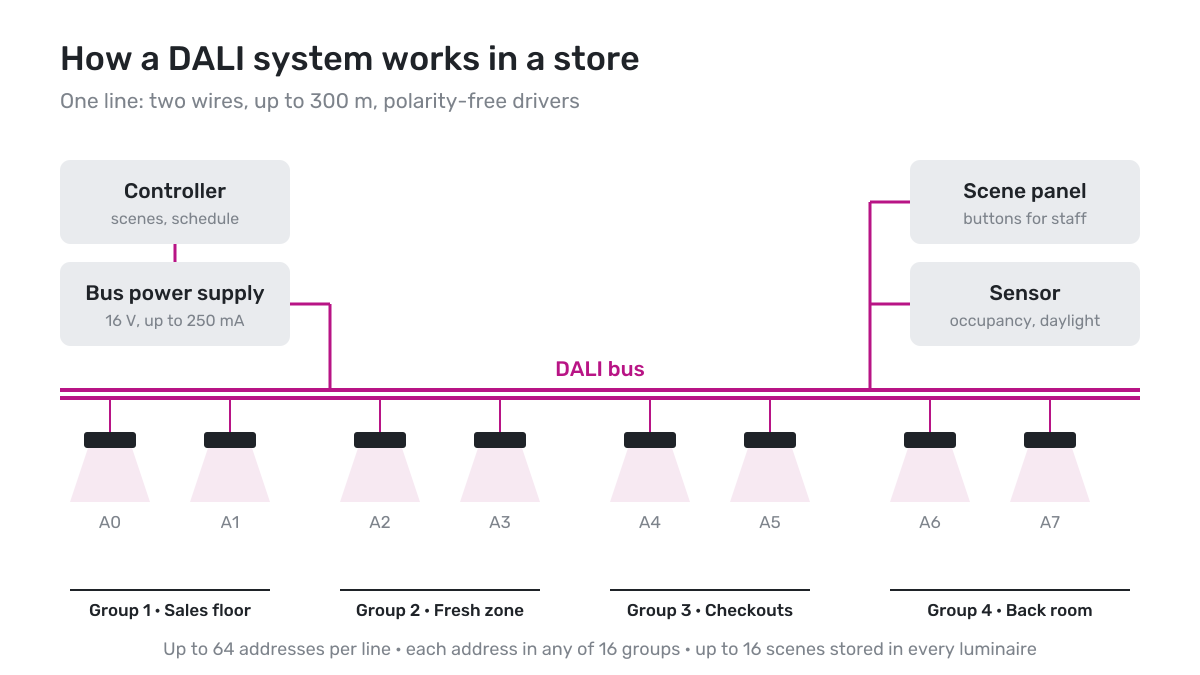
DALI (Digital Addressable Lighting Interface) is a digital lighting control protocol defined by the international standard IEC 62386. Besides mains power, two control bus wires run to the luminaires. Every driver on the bus has its own address, so the controller can switch, dim or turn off any single luminaire.
- Up to 64 addresses (0–63) on one DALI line.
- Each luminaire can belong to any of 16 groups. A group is, for example, "fresh zone" or "checkouts".
- Each driver stores up to 16 scenes, that is, preset brightness levels.
- The bus has its own power supply, typically 16 V and up to 250 mA. The recommended line length is up to 300 m.
- Drivers connect to the bus regardless of polarity, so the installer cannot wire a luminaire the wrong way round.
DALI-2 certification by the DALI Alliance ensures that drivers, sensors and controllers from different manufacturers work together. Specify DALI-2 in the project.
DALI, 1-10 V, TRIAC and wireless control compared
Stores use four ways to control light. They differ in what can be controlled and how much the installation costs.
| Method | What is controlled | Feedback | Cabling | Where it fits |
|---|---|---|---|---|
| Switches, relays, three-circuit track | whole group: on/off | none | separate circuit per group | small store without scenes |
| TRIAC (phase dimming) | whole group, brightness | none | regular mains | small interiors, boutiques |
| 1-10 V | whole group, brightness | none | 2 control wires, one circuit per group | simple systems with fixed groups |
| DALI / DALI-2 | each luminaire, groups, scenes | yes: driver status, faults | 2 wires for the whole line of up to 64 addresses | supermarkets, chains, fuel stations, malls |
| Wireless (Bluetooth, Zigbee) | each luminaire | depends on the system | no control cable | refurbishment without new wiring |
The main advantage of DALI for a store is that groups are set in software. When the layout changes, a luminaire is moved to another group in the controller, with no rewiring.
Scenes for a store: what to set up from day one
Scenes follow the schedule of a particular store. For a supermarket open 8:00–22:00, a typical set looks like this:
| Scene | When | What happens |
|---|---|---|
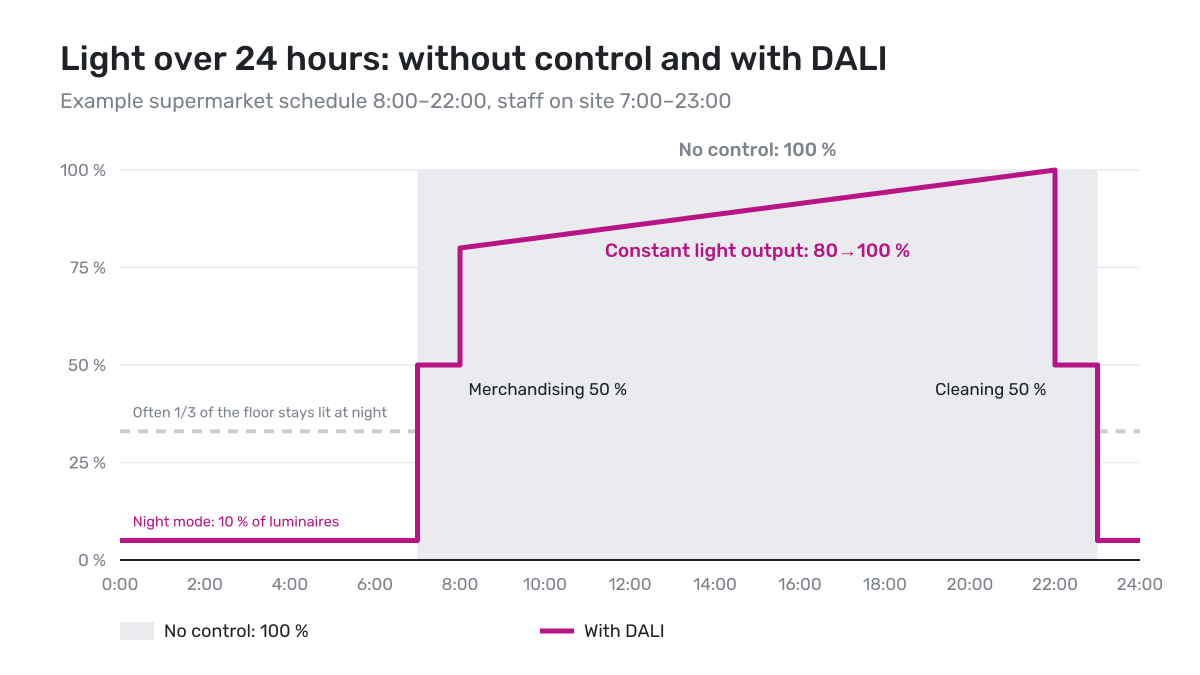
| Merchandising and deliveries | 7:00–8:00 | sales floor at 50 %, warehouse and loading dock at 100 % |
| Trading hours | 8:00–22:00 | design illuminance by zone, accents on fresh zones and promotions |
| Cleaning | 22:00–23:00 | sales floor at 50 %, accent spotlights off |
| Night mode | 23:00–7:00 | about 10 % of luminaires at 50 %: entrance, checkouts, aisles covered by cameras |
| Promotion or season | as needed | a separate group of spotlights on pallet displays and the seasonal zone |
The controller schedule switches the scenes. A button panel by the staff entrance handles exceptions: stocktaking, night deliveries, equipment checks.
Night mode instead of "a third of the floor overnight"
Without control, night lighting is usually solved the simple way: one panel circuit stays on. That is a third of the floor or more, all night. With DALI the night mode is built from individual luminaires above the entrance, the checkouts, the main aisle and the camera zones. They can be dimmed to a level that is still enough for video surveillance.
Take a 1,000 m² floor with a 9.9 kW load. A third of the floor for 8 night hours gives 3.3 kW × 8 h × 365 = 9,636 kWh a year. A night mode of 10 % of luminaires at 50 % power uses 0.495 kW × 8 h × 365 = 1,445 kWh. The difference is 8,191 kWh, or about 82,000 UAH a year at 10 UAH/kWh. Agree the night light level with your security team and camera supplier.
How much DALI saves: a 1,000 m² sales floor
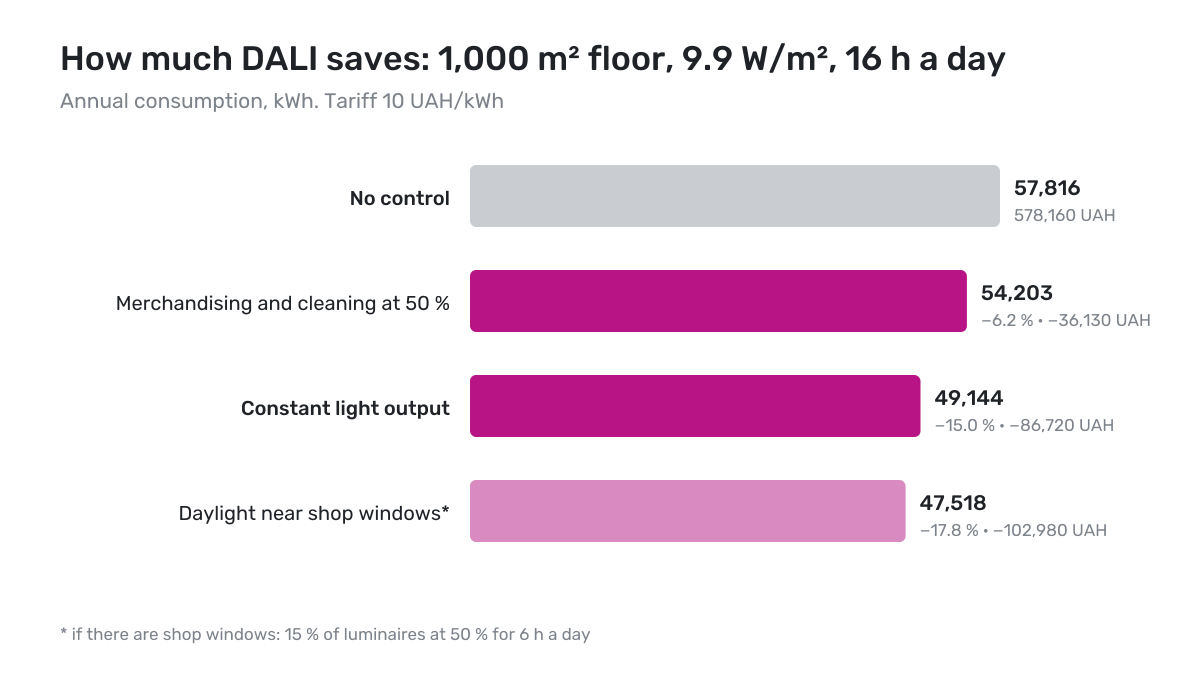
We use the same example as in the article on the total cost of ownership of lighting: 1,000 m², 9.9 W/m², 16 hours a day, 10 UAH/kWh. Without control that is 57,816 kWh and 578,160 UAH a year.
- Merchandising and cleaning at 50 %. 2 hours a day at half power save 3,613 kWh a year (6.2 %).
- Constant light output. Lighting is designed with a maintenance factor, often 0.8 for a clean retail interior. A new installation therefore delivers about a quarter more light than required. DALI caps the power at 80 % at the start and raises it gradually as the luminaires age. Averaged over the period this is about 10 % of the energy used during trading hours: 5,059 kWh a year (8.75 % of total consumption).
- Daylight near shop windows. If the store has shop windows, a daylight sensor dims the row of luminaires along them. For 15 % of luminaires at 50 % for 6 hours a day this adds 1,626 kWh.
Total without daylight: 8,672 kWh, or 15 % of consumption, which is 86,720 UAH a year. With shop windows: 10,298 kWh (17.8 %). The night mode calculated above comes on top.
For comparison, a 2012 meta-analysis by Lawrence Berkeley National Laboratory of real installations found average savings in the controlled zones of 24 % from occupancy sensors, 28 % from daylighting, 31 % from personal tuning, 36 % from institutional tuning of light levels and 38 % from combining several strategies. Most of that data comes from offices. Occupancy sensing does not help on a sales floor, because there are always people there during trading hours. So the realistic estimate for a sales floor is lower, 10–20 %, while warehouses, back rooms and corridors with occupancy sensors come closer to the research figures.
Common mistakes when introducing DALI
- Filling the line to the limit. 64 addresses is the maximum. Keep at least 10 % spare for future luminaires.
- Putting DALI spotlights on a standard track. Track spotlights with DALI control need a track with DALI conductors (in stores usually three-circuit) and a DALI adapter on the spotlight.
- No address plan. If the installation drawing does not show which luminaire has which address, commissioning and repairs take several times longer.
- Scenes are never set after the shelves are stocked. The system is installed, but every luminaire stays at 100 %. Commissioning with scene and schedule setup is a separate work stage and must be in the budget.
- Occupancy sensors on the sales floor. During trading hours they save nothing. They belong in the warehouse, toilets, corridors and staff rooms.
- Adding DALI after installation. Running new cable and replacing drivers in a finished store costs more than planning control in the design.
How to decide whether your store needs DALI
- Count the lighting hours and the real schedule: merchandising, cleaning, night mode.
- Identify the zones where light should change separately: fresh, checkouts, promotions, shop windows, back rooms.
- Calculate the savings in kWh and in money for your tariff, as in the example above.
- Compare them with the extra cost of DALI drivers, the controller, cabling and commissioning.
- Our advice: if the store is open 12 hours a day or more, or belongs to a chain with a common standard, include DALI in the design from the start.
DALI in Vision Lighting solutions
Most of our luminaires for retail come in a DALI driver version. The RAY-L, LINK, RAY-R and EDGE-LINE linear luminaires provide general light over the shelving, and continuous lines can be assembled in the continuous line configurator. SHOOTER-M and SHOOTER-L track spotlights with a DALI adapter go on a three-circuit track with DALI conductors. We explain how it differs from a standard track in "1-phase vs 3-phase lighting track: how to choose", and how to choose the spotlights themselves in "How to choose track spotlights".
Controllers, occupancy and daylight sensors and scene panels are in the Lighting control section. During lighting design we split the floor into groups, prepare the DALI address plan and calculate the savings for your schedule. Installation and commissioning are done by our electrical installation team.
FAQ
How many luminaires can one DALI line take?
Up to 64 addresses per line. Keep at least 10 % spare in the design. A large floor uses a controller with several lines.
Can DALI be added to an existing installation?
Yes, but the drivers or luminaires have to be replaced and a bus cable installed. For a finished store without new wiring, wireless control is sometimes simpler.
How much does DALI save in a supermarket?
In our 1,000 m² example, 15 % of consumption, about 87,000 UAH a year. With daylight near shop windows, up to 18 %. A night mode instead of a third of the floor overnight adds about 8,000 kWh more.
What is constant light output?
A function in which new luminaires run at reduced power and the controller raises it over time. Illuminance on the goods stays at the design level for the whole service life, and consumption is lower in the first years.
How is DALI-2 different from DALI?
DALI-2 is the DALI Alliance certification programme based on the latest edition of IEC 62386. It covers not only drivers but also sensors, push buttons and controllers, so equipment from different manufacturers is compatible.