Track Lights
 Linear Lights
 Track System
 Decorative Lights
 Recessed Light
 Pendant lights
 Surface mounted lights
 Panel lights
 Street Lighting
 Magnetic Lighting System 48V
 Magnetic Lighting System 48V
 Invertors
 Lighting control
Shop lighting: how light affects the goods and the way customers behave
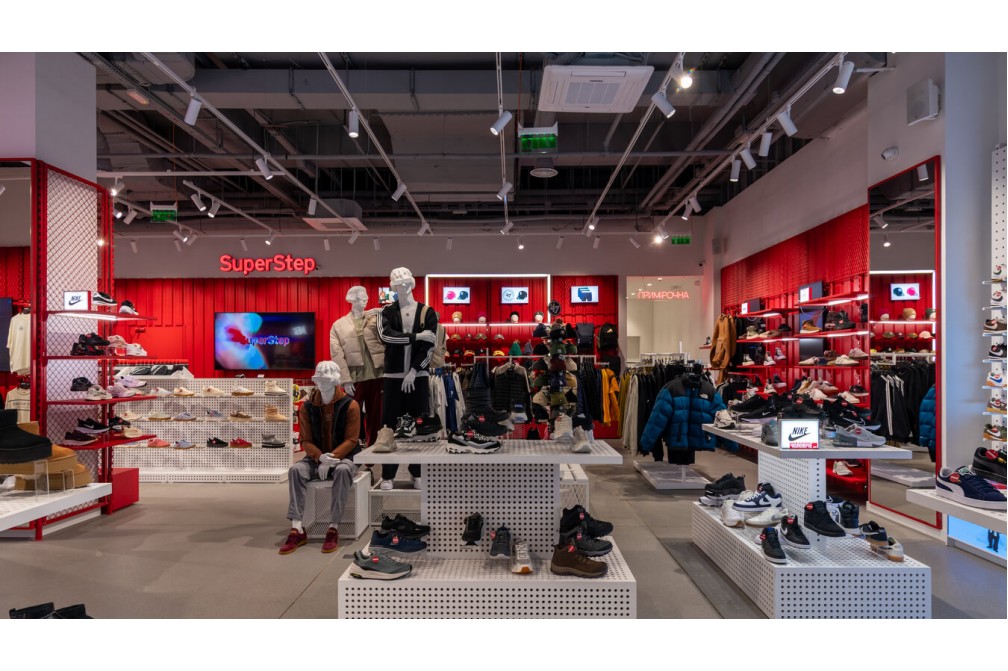
Lighting in a shop is more than a visual environment that lets people see the space and the objects in it. It changes how the goods look, how customers move and what impression the brand leaves. It is not enough to place the number of luminaires needed for visibility. Light has to create a pleasant atmosphere, pick out windows and shelving, help visitors find their way and keep staff comfortable at work. It shapes the whole perception of the interior.
In a well-lit shop the customer finds a route and the products easily. They see the entrance, notice the window, understand where the goods are, where the promotions are and where the checkout is. The products look three-dimensional, colours are not distorted, shelves do not sink into shadow and the luminaires do not dazzle. That is why retail lighting is designed as a whole, around the functional zones of the space, the layout of the fixtures and the types of goods: background and accent light, window lighting, the checkout, exterior lighting and controls.
The main mistake is trying to light the whole shop the same way. Even light across the whole ceiling looks like the simple answer, but in retail it often makes the space flat. The customer sees everything and nothing catches their eye. Good shop lighting is built on different scenes: the aisles can be calmer, the displays brighter, the window more expressive, and the checkout visible and convenient.
Where shop lighting starts
Working with light starts with the space and the type of shop, not with choosing luminaires. The same spotlight can work beautifully in a clothing boutique and be completely out of place in a grocery section. Linear luminaires light long aisles well but are not meant to create an accent on a window. A track system suits shops with a changing display, but it also has to be sized correctly for power, beam angle and direction.
Before design begins it helps to understand the product range, how the brand's customers behave and what the sales area is like, so the first stage answers these questions:
- what is sold and what drives the customer's choice;
- where the shop is: in a mall, a stand-alone building, inside a business centre and so on;
- daylight and the number of windows;
- ceiling height and whether recessed mounting is possible;
- the zoning plan, furniture and fixture layout;
- seasonality, how often the range changes and the planogram.
A shop in a mall, for example, usually competes for attention with neighbouring windows, signs and bright common areas. If it is too dark inside, people simply walk past. A stand-alone shop with a street entrance has other challenges, such as the facade: for the evening, the sign, the entrance and the exterior lighting matter.
Zoning: why one light never fits a whole shop
To get good lighting, treat the shop as a set of functional zones. Each has its own task and needs its own lighting scene: the window should attract attention, the sales floor should be comfortable and bright enough, the fixtures should make the range presentable, the aisles should make navigation easy, the fitting rooms should light the figure correctly, and the checkout should be convenient for the cashier and for the customer completing the purchase.
This approach matters in retail because light is directly linked to customer behaviour. Convenience, comfort, attractiveness, the right accents and a visual match with the brand style influence the decision to buy and the wish to come back.
Entrance and exterior lighting
The entrance zone should be clear at first glance. A person should not have to look for where the shop begins and how to get in: illuminated or backlit signs, accents on the doors, facade luminaires, linear lighting or outdoor LED luminaires are all there to attract attention, invite people into the sales floor and make the entrance easy to find.
For shops in stand-alone buildings this is especially important. By day the facade can attract with its architecture and sign, but in the evening it is the light that decides how visible the shop is from the street.
The window
A window is not just glass with goods behind it. It is the shop's calling card, presenting it around the clock. It should be lit brighter than the surrounding space without turning the display into an overlit patch. Volume matters here: pick out the mannequins, the shelves, the main product, the decorative elements and the depth of the composition.
Windows are usually lit with track spotlights, adjustable luminaires, downlights and linear lighting. In this article we keep them in the general context, because shop window lighting is a large subject of its own, with glass, reflections, the angle of light, contrast and the composition of the display itself. We will cover it in a separate article.
The sales floor
The sales floor should be bright enough for the customer to feel comfortable, but not uniform across the whole area. Background lighting provides basic visibility; accent lighting picks out the goods. The accents are what make the space feel alive: they light stands, shelves, island displays, mannequins, promo zones and new collections.
In the past the usual approach was to flood the floor with even light. That can work in technical rooms, but in retail it does nothing for the presentation of the goods. It is far more effective when the display is lit brighter than the aisles. Then the customer looks where they should without thinking about it.
In shops inside malls the illuminance level usually has to be higher than in intimate boutiques. The reason is simple: there are many visual stimuli and competing windows nearby. If the sales floor looks darker than the neighbouring shops, it can lose before the customer has even looked at the range.
Checkout and the checkout zone
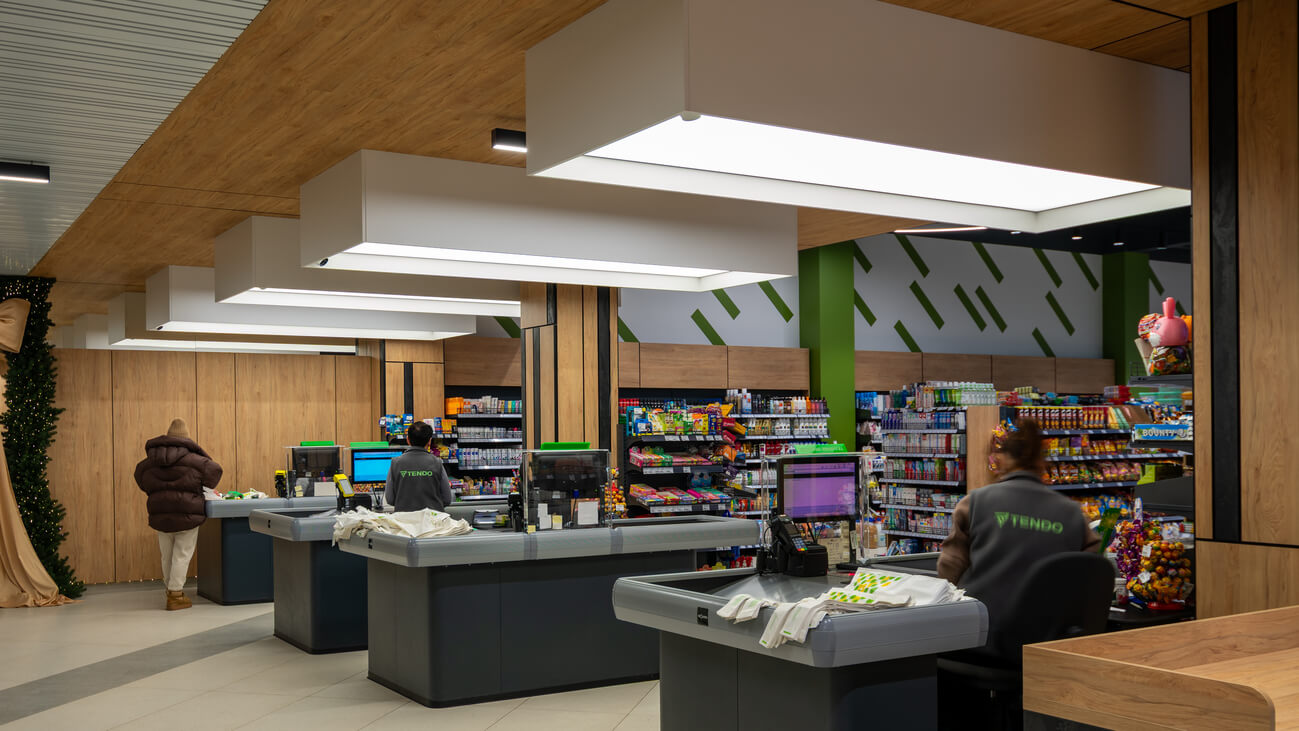
The checkout is a working area of the shop and at the same time the final point of the customer's route. It has to be convenient for staff and comfortable for the customer. The light must not dazzle, cast hard shadows on the terminal or cause discomfort during payment and packing.
The checkout zone is often used to display small products, accessories or impulse purchases. They should not be left in half-light. A few precise accents on the shelves by the checkout make this area more noticeable, but it is important not to overload it with light: the customer is already completing the purchase, and the lighting should help, not irritate.
Which luminaires are used in shops
Professional shop lighting rarely relies on one type of luminaire. A project usually combines several solutions, each with its own task.
Track luminaires
Track lighting is convenient in the parts of the shop where the light needs to adapt and accents need to be changed quickly. The luminaires can be moved along the track, rotated and redirected to a new display or a seasonal offer. It is a practical solution for boutiques, showrooms and shops selling clothing, footwear, electronics, cosmetics and other goods where the display changes.
Track spotlights are used to pick out windows, mannequins, wall shelving, island displays and product zones that need emphasis. The beam angle has to be chosen correctly: a narrow beam gives a crisp accent, a wide one lights a larger area more softly.
Recessed and surface-mounted luminaires
Recessed luminaires suit neat background light or directed light in rooms with suspended ceilings. They do not clutter the interior and can be almost invisible. Surface-mounted luminaires are used where the body cannot be built into the ceiling, or where the luminaire itself is part of the design. They come in different types and can provide both background and accent light, or complement a track system.
Linear luminaires
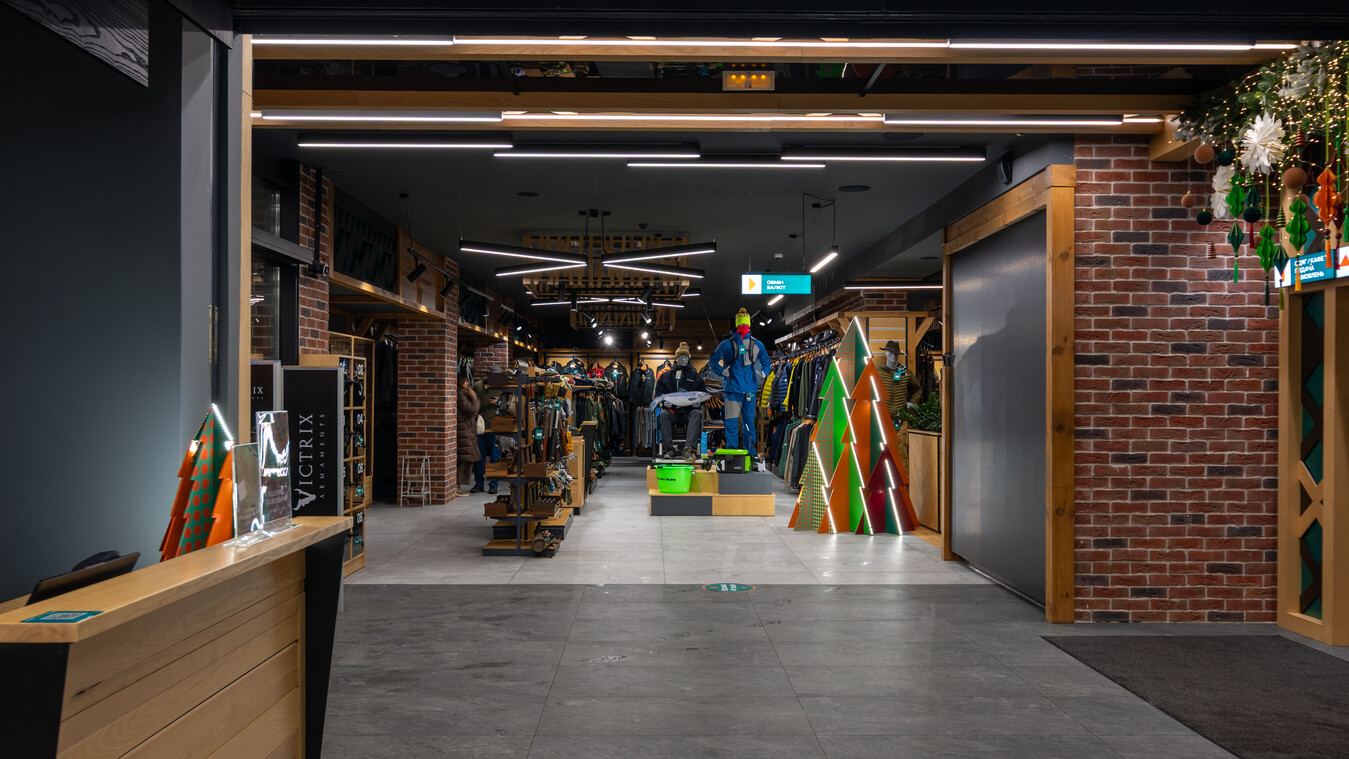
Linear luminaires are often used in large sales floors, supermarkets, showrooms and spaces with long aisles. They light the rows evenly, emphasise the geometry of the space and give the ceiling a clean, modern look.
If the shop has an open layout, linear light can become the base of the lighting scheme, with track or adjustable luminaires adding accents on the goods.
Pendant luminaires
Pendants work when the ceiling height allows the light source to be lowered and made part of the interior. They are often used above the checkout and island tables, in the consultation area or to pick out individual interior elements.
In retail lighting pendants should not be purely decorative. They have to give the right light without getting in the way of movement or the view of the goods.
Typical shop lighting layouts
Most shops use one of four lighting layouts. The choice decides how many fixtures you need, how they are controlled and how easily the light can follow a new merchandise layout.
Even general lighting
Linear or panel fixtures give the same illuminance across the whole floor. This suits grocery stores, supermarkets and pharmacies, where shoppers need to see every shelf equally well.
General lighting plus accents on the goods
Linear fixtures provide the base level, and track spotlights pick out displays, mannequins and shop windows. The most common layout for fashion, footwear and specialist retail.
Track spotlights only
The whole floor is lit by spotlights on a track. The light is easy to re-aim for a new layout, but beam angles must be chosen so that aisles are left without dark zones.
Layered gallery-style lighting
Several independent groups: general, accent, wall and window lighting, often with DALI control. Boutiques, jewellery and flagship stores are lit this way, where light supports the brand image.
A DIALux lighting calculation based on your floor plan shows which layout fits your shop.
Types of store lighting
Store lighting is split into several types by task. Each type is designed separately and then combined into one scheme.
General (ambient) lighting
Provides basic visibility on the sales floor and in the aisles. Usually these are linear or panel luminaires spaced evenly across the ceiling.
Accent lighting
Highlights the merchandise: shelves, racks, island displays, mannequins, promo zones. It uses track spotlights with a narrow or medium beam angle.
Window lighting
Works towards the street or the mall gallery. The shop window has to be brighter than the sales floor, otherwise it gets lost among its neighbours.
Decorative lighting
Lighting for walls, niches, signage and interior details. It builds the brand image but does not replace light on the products.
Emergency lighting
A separate group of luminaires, or luminaires with an emergency power unit (EM), that stay on during a power cut. Fire safety rules require it, so it is planned at the design stage.
Luminaires for the sales floor: how to choose
The type of luminaires for a sales floor depends on the store format and the ceiling height.
- Grocery store and supermarket: linear luminaires above the rows of shelving, so the shelves are lit evenly over their full height. For fresh food, spotlights with special spectra for meat, fish, bakery, fruit and vegetables are added.
- Fashion and footwear: linear general light plus track spotlights on mannequins, walls and island displays.
- Pharmacy, cosmetics, electronics: even general light and separate lighting for shop windows and counters, where accurate colour rendering of packaging matters.
For a sales floor with a ceiling of about 3.5 m, track spotlights and suspended linear luminaires work well. The higher the ceiling, the narrower the beam angles need to be, so the light reaches the products instead of spreading across the room.
Lighting for shopping centres and retail facilities
A store inside a shopping centre is lit differently from a standalone street store. A mall is full of bright shop windows and advertising, so illuminance on the sales floor and in the window is set higher to keep the store from looking dark next to its neighbours.
Most shopping centres have technical requirements for tenants: permitted power, luminaire types, controls, emergency lighting. It is worth getting them before the design starts, because they determine the choice of equipment.
Other retail facilities have their own tasks. At a fuel station, the light serves both the shop and the canopy area. In a pharmacy, even lighting of the displays and accurate colour of packaging matter. In a large supermarket, the key is even light over the full height of the shelving.
Why LED has become the standard for shops
LED lighting is chosen for shops not only because it is energy-efficient and saves money. LED luminaires allow more precise work with light: colour temperature, colour rendering index, beam angle, power, optics and the method of control can all be selected.
For retail this matters. A shop needs stable light without much heat, with good colour rendering and a long rated life, for daily operation over years. But the word LED by itself does not guarantee a good result. An LED luminaire can be economical and still be wrong for the task. A wide beam will be too soft for an accent on a mannequin, and light that is too cool can make the interior feel hard and unwelcoming.
So buying shop lighting is not simply picking luminaires from a catalogue. You need to understand where they will be placed, what they will light, how they will combine and what overall effect they will give.
Key parameters of retail light
Brightness is not the only thing that matters in a shop. Light can be powerful and still be unpleasant, dazzling or render the colour of the goods wrongly. When choosing luminaires, look at several characteristics.
- Colour temperature. Warm light creates a softer atmosphere, neutral suits most retail spaces, and cool light can emphasise technology or freshness but needs careful handling.
- Colour rendering. The more accurately light renders colour, the more natural the goods look. This matters most for clothing, footwear, cosmetics, decor, furniture and food.
- Beam angle. A narrow beam is needed for accents, a wide one for general light and even illumination.
- Glare control. A luminaire must not dazzle the customer, reflect in glass or cause discomfort.
- Adjustability. Adjustable and track luminaires give more freedom when the display changes.
Vertical surfaces deserve separate attention. If only the floor is lit, a shop can look dark even with a normal number of luminaires. Shelves, walls, racks, windows and product zones have to receive enough light, because that is where the customer looks.
Why a shop needs a lighting design
A lighting design for a shop exists to set the logic of good, functional light in advance instead of correcting mistakes after installation. At the planning stage the number of luminaires, their positions, power, beam angles, switching scenes and the link to the retail fixtures are all worked out.
Without a design, problems appear: dark corners, overlit aisles, weak lighting of the goods, reflections in glass, unnecessary luminaires or, on the contrary, gloom. In some cases the owner has to rework the ceiling, add tracks, move the wiring or replace luminaires in a finished shop.
Professional shop lighting design rests on standards and calculations, but it also takes the commercial task into account. Light should help present the goods correctly: pick out the right positions, support the brand atmosphere and make the space convenient and visually coherent.
Common mistakes in shop lighting
The first mistake is saving on accent light. If the whole budget goes on general background lighting, the sales floor may be bright enough but featureless. The goods do not stand out, and the shop looks like an ordinary well-lit room.
The second mistake is choosing luminaires by looks alone. A handsome body does not solve the task if the luminaire has the wrong technical, electrical or optical parameters, such as poor optics, low colour rendering or the wrong colour temperature.
The third mistake is ignoring the surroundings. A shop in a mall, a shop with a street facade and a small showroom need different lighting solutions. One has to compete with a bright neighbour, another needs intimacy and contrast, a third needs even light for a large range.
Another frequent problem is the absence of scenes. Everything switches on at once, with no separation between the window, the floor, the checkout, an evening mode and promo zones. As a result the shop uses more electricity and the lighting loses its dynamics.
Summary
Shop lighting is not a finishing touch added after the fit-out but part of the concept of the sales floor and the brand identity. It should be designed together with the interior, as the technical basis for the space looking the way the designer intended.
Good retail light does not draw attention to itself unless that is the intention. It makes the goods visible, helps the customer move around, emphasises the important zones and creates the right impression. To achieve this, combine background, accent, window and exterior lighting instead of trying to solve every task with one group of luminaires.
LED lighting, track systems, linear, recessed and surface-mounted luminaires offer many possibilities. But the result depends not on the amount of equipment but on how precisely it is chosen for the particular shop.
FAQ: questions about shop lighting
Which lighting is best for a shop?
A combined scheme works best: general background light for comfortable visibility, accent light for the goods, separate lighting for the windows, the checkout and the entrance. The specific luminaires are chosen for the shop format, taking into account ceiling height, the interior and the type of goods.
Does track lighting suit a shop?
Yes. Track luminaires suit shops where the light has to adapt to the display and accents change often. They can be aimed at windows, mannequins, shelves, promo zones and new collections.
Why not simply light the whole shop evenly?
Even light gives visibility but does not direct the customer's attention. In a retail space the goods, the windows and the key zones have to stand out. Without accents a shop looks flat, even when there is enough light.
Why does a shop need a lighting design?
A design works out in advance the number of luminaires, their placement, power, beam angles and switching scenes. It reduces the risk of mistakes during installation and gives lighting that is not just bright but considered and in line with expectations.
What makes LED lighting convenient for shops?
LED luminaires are economical and long-lasting, and they allow precise selection of colour temperature, beam angle, power and colour rendering. The main advantages are energy efficiency, controllability and a predictable result. But even they have to be chosen for the specific task, not only by price or appearance.