Panel lights
 Linear Lights
 Track Lights
 Recessed Light
 Decorative Lights
 Track System
 Surface mounted lights
 Pendant lights
 Magnetic Lighting System 48V
 Magnetic Lighting System 48V
 Street Lighting
 Lighting control
 Invertors
Jewellery store lighting: accents for showcases and jewellery
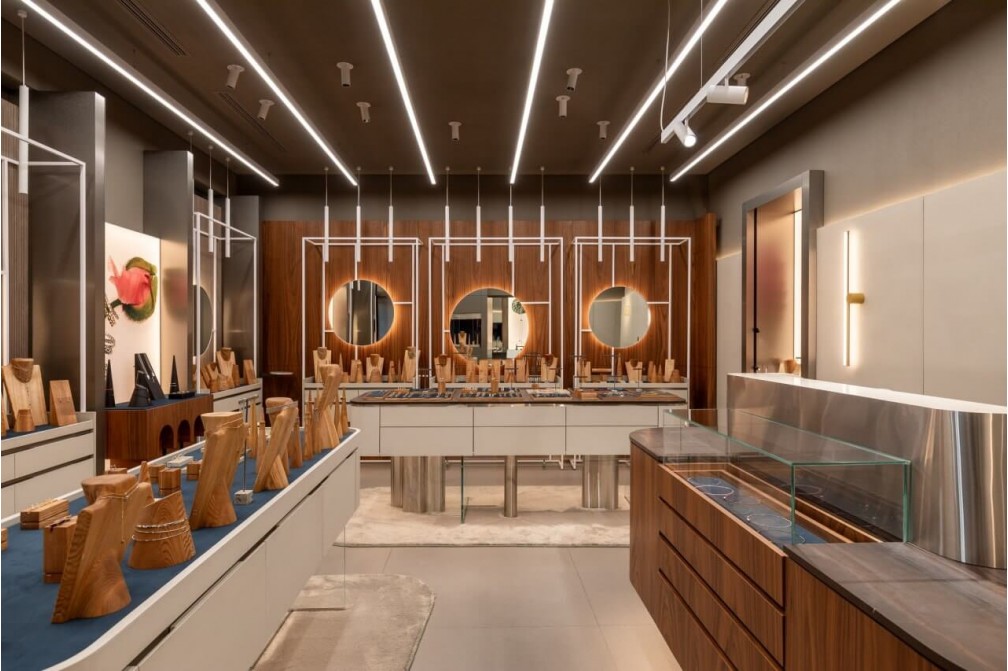
A jewellery store asks more of its lighting than almost any other shop. The products are small, and every detail counts: the tone of the metal, the cut of the stone, the texture of the surface, the colour of the inserts. Good visibility alone is not enough. Light has to give the piece volume and presence, keep colours natural and stop the glass showcase from turning into a sheet of reflections.
That is why jewellery lighting works differently from the light in most retail spaces. The interior can stay visually calm while the jewellery and the showcases are picked out with precise accents. And the same light rarely suits every product in the store: gold, silver, diamonds, coloured stones, pearls and watches each ask for something different.
What light has to show in a jewellery store
A customer looks at a piece from close range and notices poor presentation at once. Light that is too diffuse makes metal and stones look flat. Light that is harsh or badly aimed creates glare on the glass and on polished surfaces.
The combination that works best is general light plus accent light. The first helps people find their way around the store and sets the mood; the second brings out the shape, the cut and the sparkle of the piece and separates it from the background.
Well-planned jewellery lighting should bring out the beauty of the pieces and help the customer see what makes them special:
- the natural tone of the metal and the stones;
- the shape, facets and volume of the piece;
- the shine of the surfaces;
- small decorative details;
- the difference between pieces displayed side by side;
- the composition of the showcase without overlit patches.
The showcase is the main accent
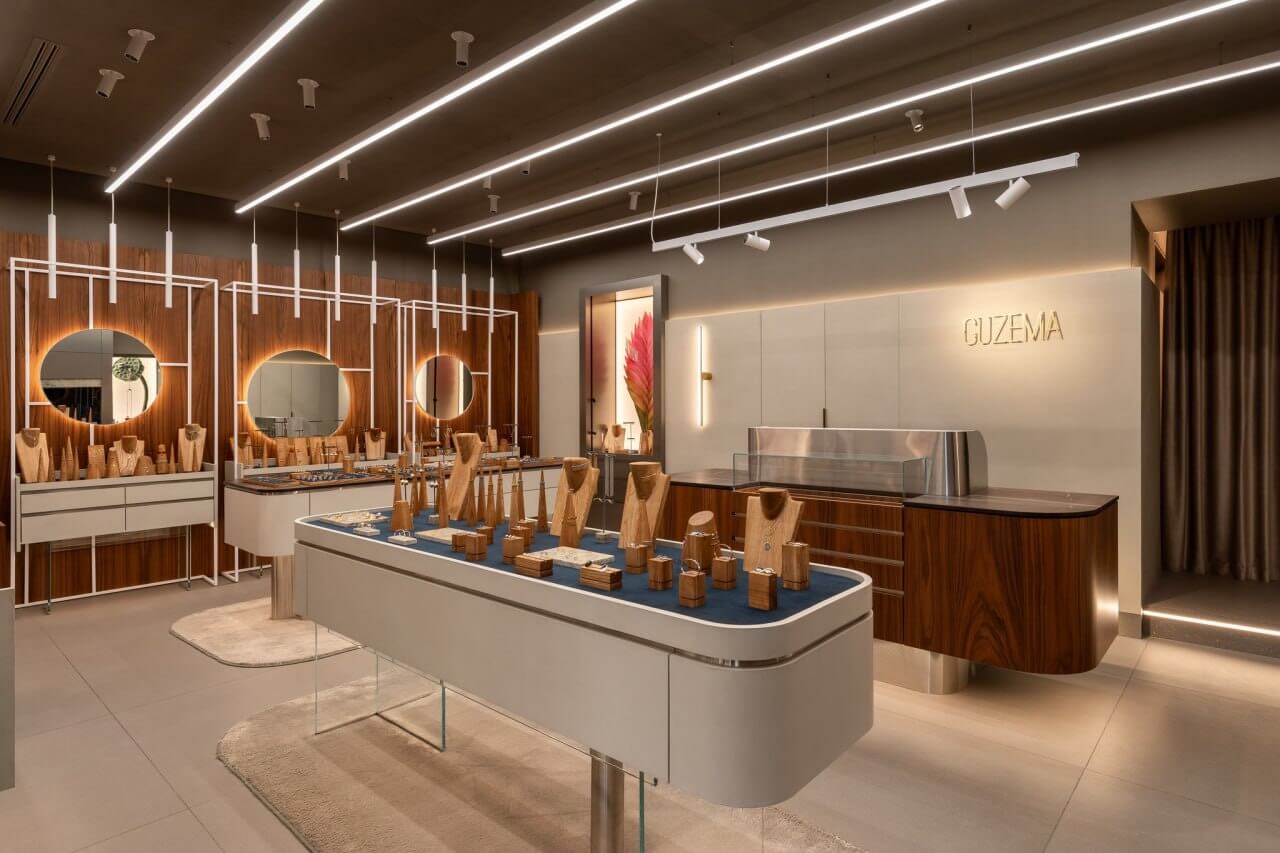
Most of the lighting work in a jewellery store happens inside and around the showcases. The pieces are small, usually behind glass and surrounded by surfaces that reflect light. So the lighting of the display shelves has to be planned together with the design of the fixtures, taking into account how the pieces are laid out and from which angle the customer sees them.
If a light source is placed badly, the customer sees the reflection of the luminaire instead of the jewellery. Purely vertical light does not always flatter a piece either: some surfaces are bright, others stay in shadow. The beam has to be aimed so that it gives a clear sparkle and keeps the details legible at the same time.
The background behind the jewellery matters too. A dark base under the display strengthens contrast and helps light metals and stones stand out, but with too little light small details can get lost. A light background makes the display feel lighter, but it needs careful brightness control so the piece does not merge with it.
In long showcases the light should be spread evenly along the whole display, while leaving room to emphasise individual positions: the central piece, a new collection or the model that should become the main visual accent.
Sparkle, cut and the direction of light
The sparkle of a piece does not depend on brightness alone. Polished metal reflects differently from brushed metal, and the facets of a stone return light at different angles, so simply turning the intensity up does not help.
Light that is too even reduces the play of reflections, while overly hard spots create bright points that pull attention away from the jewellery.
This is why jewellery lighting is built from controlled accents that bring out the material and the cut without becoming the centre of attention themselves.
Gold, silver and coloured stones
One colour temperature does not suit every material equally well. Warmer light brings out the yellow and reddish tones of gold and makes them richer. Silver, white gold and other light metal surfaces look better under more neutral light, which gives a sense of cleanness and coolness.
This does not mean the store has to be split into zones with sharply different light colour. With a mixed range it matters more to find a common base and, where needed, use separate accents for different product groups.
For coloured stones, colour rendering is critical: the light must not shift their characteristic tone or make saturated colours look muddy or dull. The same applies to gold and light metals: with a low colour rendering index they look less natural and less expressive.
Lighting the showcase and the fitting area
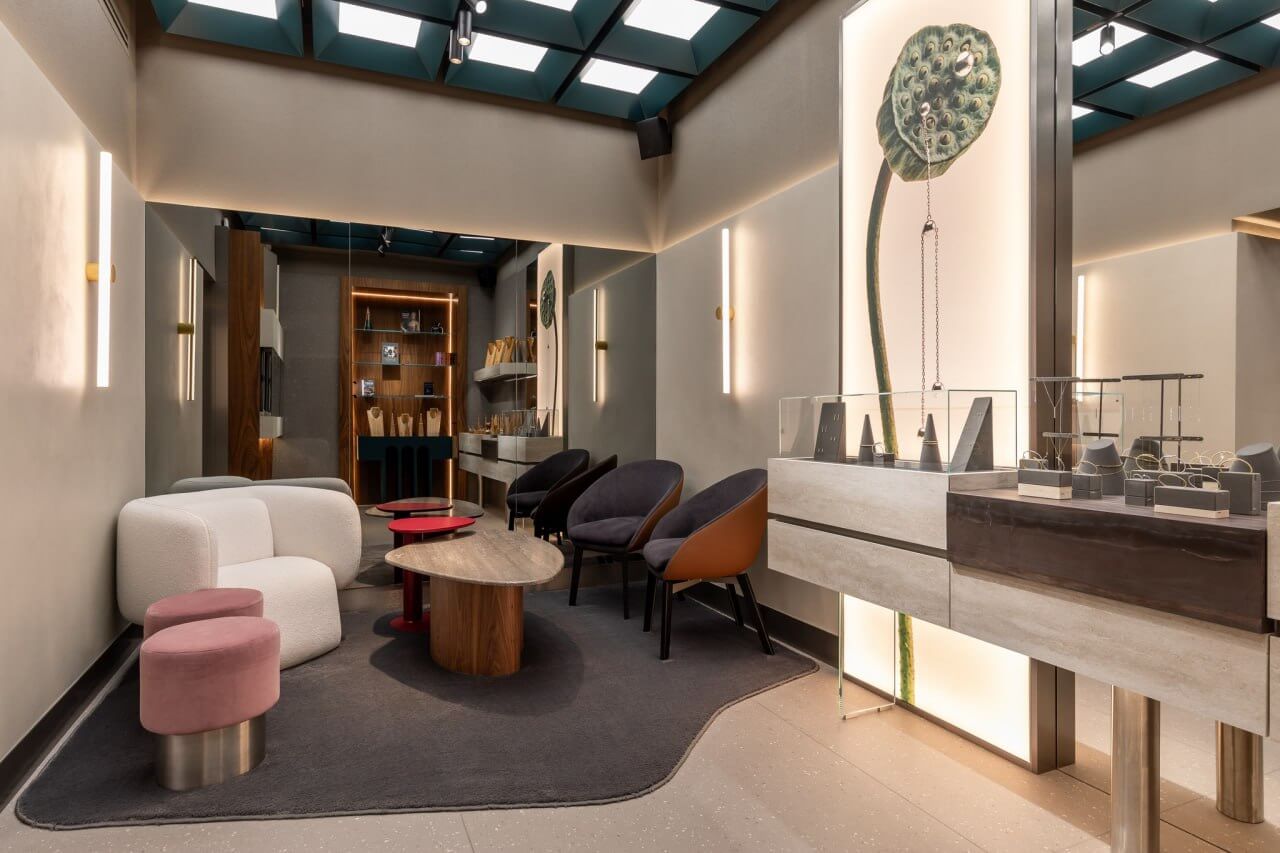
A piece has to look good not only behind glass. Once it is taken out of the showcase, the customer looks at it on a hand, at the neck or next to the face. So the light at the consultation desk and by the mirror has to match the light in the showcase.
If a ring looks striking on display but goes dull or visibly changes tone when tried on, the customer feels a mismatch. When planning the lighting, look at the whole path of the piece: the showcase, the consultation area, the mirror and the checkout.
LED lighting for jewellery stores
LED luminaires make it possible to choose colour temperature, spectral characteristics, direction and light distribution precisely. Compact sources are easy to build into showcases and retail fixtures and to combine different types of lighting.
At the same time there is no single solution for every task. General showcase lighting can be done with linear luminaires, individual pieces can be picked out with small spotlights, and large compositions work best with a mix of built-in light and external accent luminaires.
LED lighting for jewellery showcases has to be chosen for the specific fixture design and the range displayed in it. Exposed bright points, reflections of the sources in the glass or an uneven line of light become obvious next to small pieces and spoil the impression of the whole display.
The sales floor and the hierarchy of light
Jewellery store lighting is not limited to the showcases. The sales floor is the general background against which the pieces are presented. If the whole interior is too bright, the showcases lose contrast. If the space is too dark, the transition to brightly lit pieces becomes too abrupt.
A clear hierarchy of light works best: the room stays visually calm and legible, and the strongest accents are concentrated on the jewellery. In premium interiors the luminaires themselves are often integrated into the design with recessed solutions, compact track systems and concealed linear lighting.
The entrance window: the customer's view
A window facing a mall gallery or the street is seen from a distance and in motion, so a person first sees the overall composition and only then the individual pieces.
There is no need to light every item equally brightly. A few precise accents make a clearer composition than many identical spots of light. You can emphasise the central piece, a group of products, the logo or another element that matters in the composition.
Glass and the reflections of the surroundings add to the difficulty. So the entrance window must be checked from outside, from the places and at the distance from which most customers actually see it.
What most often spoils jewellery lighting
One of the main mistakes is trying to make the showcases as bright as possible. With brightness come more reflections and overlit patches, and the pieces start to compete with each other visually.
Lighting the whole range the same way, ignoring the difference between gold, silver and coloured stones, is just as much of a problem. Another common mistake is placing luminaires badly in relation to the glass, so the customer sees the reflection of their own silhouette or of the light source instead of the jewellery.
If the display changes regularly, plan for adjustable accent luminaires. A new collection may differ a lot in piece size, metal colour and placement inside the showcase, so a fixed lighting scheme quickly goes out of date.
Checking the lighting after installation
Assess the light only once the real pieces are in the showcases. Look at them the way a customer does: from a distance, up close, standing in front of the glass and walking along the display.
Check that the colour of the metal looks natural and the cut of the stones is clearly visible, that the reflections are expressive but not intrusive, and whether the luminaires are reflected in the glass. Then take a piece out and look at it in the consultation area: the impression should not change sharply.
From a distance the jewellery and the composition of the showcases should come first, not the bright points of the luminaires. As the customer approaches the display, the light should reveal the details of the pieces.
Summary
Jewellery store lighting needs close attention to the colours and sparkle of the pieces and to the surfaces that reflect light. What matters is not the maximum brightness of the room but how well the light shows the material, the cut and the details of the piece without stray reflections.
Good jewellery lighting draws almost no attention to the luminaires themselves. The customer sees the piece, its colour, shape and texture, and keeps the same impression when it is taken out of the showcase to try on.